What Is a Landing Page Conversion? Definition, Significance, and Ways to Make It Better
Written by: CRO & Digital Marketing Content Team Last updated: July 28, 2026 Fact-checked against: Unbounce Conversion Benchmark Report, WordStream conversion data, HubSpot marketing research, and Nielsen Norman Group UX studies
Your landing page pulls in traffic, but the numbers stay flat, and every visitor who leaves without acting drains your ad budget. That gap between clicks and results is exactly what a landing page conversion measures. This guide breaks down the real definition, the formula, current benchmarks, and the exact steps that turn casual visitors into paying customers.
What Is a Landing Page Conversion? (Definition & Meaning)
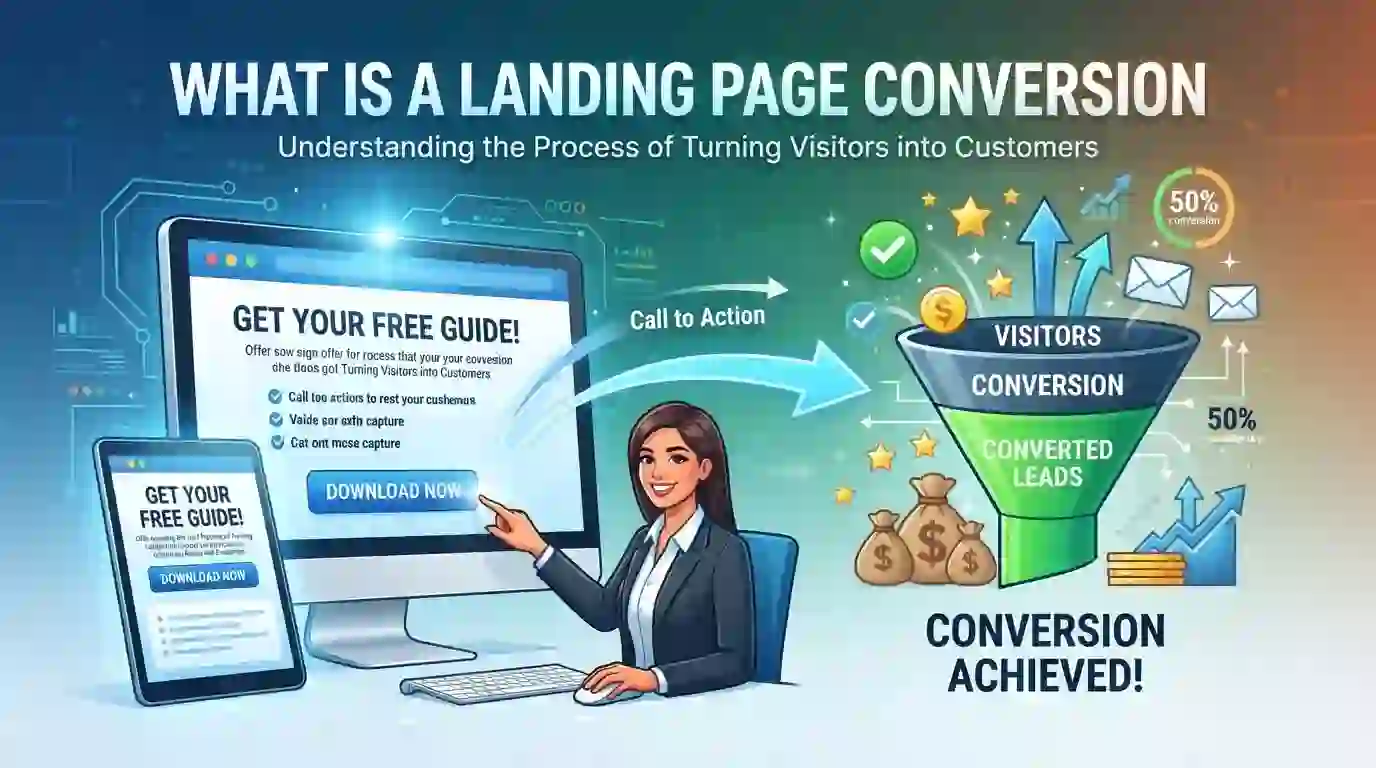
A landing page conversion happens when a visitor completes the one specific action a page asks them to take — filling out a form, starting a free trial, booking a call, or buying a product. It is the single moment a stranger turns into a lead, subscriber, or customer.
The meaning behind the term is simple: a landing page exists for one goal only, and a conversion is proof that the goal was met. Unlike a homepage, which offers dozens of paths, a landing page removes the navigation menu, the extra links, and the distractions. Visitors have exactly two choices: convert or leave.
After building and testing landing pages across SaaS, ecommerce, and lead-generation campaigns, one pattern shows up again and again: pages with a single, clear conversion goal consistently outperform pages that try to do three things at once.
Common conversion examples include:
- Submitting an email address for a newsletter
- Downloading a guide, template, or ebook
- Registering for a webinar or event
- Starting a free trial or demo request
- Completing a purchase
- Booking an appointment or consultation
Why Landing Page Conversions Matter for Your Marketing Results
This single action is the return on every dollar spent driving traffic. Without it, ad spend, SEO effort, and email campaigns produce visits but no revenue.
Marketing teams track this number because it connects two worlds: traffic and business outcomes. A page can receive thousands of visits, but if nobody converts, the traffic has no commercial value.
Here is why this metric carries so much weight:
- It measures message-market fit. A low conversion rate often signals that the offer does not match what the visitor expected.
- It protects ad budgets. Paid traffic that does not convert is wasted spend, regardless of how many clicks it generates.
- It reveals friction points. Drop-off patterns show exactly where visitors lose interest, from a confusing headline to a form with too many fields.
- It fuels compounding growth. A conversion rate that climbs from 2% to 4% doubles results from the same traffic, at no extra ad cost.
How a Landing Page Turns a Visitor Into a Conversion
The journey from click to conversion follows a predictable path, and understanding each stage helps you find where visitors fall off.
- The visitor arrives from an ad, email, search result, or social post with a specific expectation.
- The headline confirms the match. Within seconds, the visitor decides whether the page delivers what the ad promised.
- The body content builds the case, using benefits, proof, and clear formatting to keep the visitor reading.
- The call-to-action (CTA) prompts the decision. A strong CTA button removes hesitation and states exactly what happens next.
- The conversion event fires. The form is submitted, the purchase completes, or the signup is confirmed, and the visitor moves to a thank-you page or confirmation screen.
Every conversion depends on this chain staying intact. Break one link — a slow load time, a mismatched headline, a form that asks for too much — and the visitor exits before reaching the final step.
Macro vs. Micro Conversions: Two Types Explained
Not every conversion carries the same weight. To precisely monitor funnel health, marketers divide them into two groups.
Macro conversions are the primary goal of the page — a purchase, a signed contract, or a completed demo request. This is the action the entire campaign is built around.
Micro conversions are smaller steps that signal interest along the way, such as watching a product video, scrolling past 75% of the page, or clicking to expand pricing details. They do not close the deal, but they show engagement and help predict who is likely to convert later.
| Conversion Type | Example | What It Tells You |
|---|---|---|
| Macro conversion | Purchase, signed demo, paid signup | Direct revenue impact |
| Micro conversion | Email signup, video watch, PDF download | Early buying intent |
| Macro conversion | Free trial activation | Product qualification |
| Micro conversion | Pricing page click, FAQ expand | Consideration stage |
Tracking both types gives a fuller picture than watching the overall conversion rate alone, especially for longer sales cycles.
Core Elements That Drive a High-Converting Landing Page
A high-converting page rarely happens by accident. It results from specific, testable elements working together.
- A benefit-driven headline that matches the ad or email that brought the visitor there
- One clear call-to-action, repeated no more than two or three times, never competing with a second offer
- Reviews, customer logos, or usage statistics are examples of social proof that might be positioned next to the call to action.
- A short, focused form that asks only for information the follow-up actually requires
- Mobile-first design, since more than half of landing page traffic now arrives on a phone
- Fast load speed, because every additional second of load time drops the conversion rate measurably
- A value proposition above the fold, visible before any scrolling
Research from Nielsen Norman Group on web usability found that concise, scannable copy improves task success dramatically compared to dense paragraphs. Visitors scan first and read second, so conversions improve when the copy respects that behavior.
How to Calculate Your Landing Page Conversion Rate (Formula + Example)
The conversion rate formula is straightforward:
Conversion Rate = (Number of Conversions ÷ Number of Visitors) × 100
For example, if your landing page received 2,000 visitors last month and 84 of them completed the form, the math looks like this:
84 ÷ 2,000 = 0.042
0.042 × 100 = 4.2% conversion rate
To track this accurately, connect your landing page to an analytics tool and define the exact conversion event — a form submission, a button click, or a completed checkout — before the campaign launches. Without a clearly defined event, conversion tracking data becomes unreliable.
Average Landing Page Conversion Rate by Industry (2026 Benchmark Data)
Conversion rate benchmarks vary widely depending on the source, the industry, and how “conversion” is defined, so treat these figures as a directional guide rather than an exact target.
According to Unbounce’s benchmark analysis covering more than 464 million visitors and 57 million conversions across 41,000 landing pages, the median landing page conversion rate sits at 6.6% across all industries combined. Separately, WordStream’s broader cross-industry dataset reports a lower average of 2.35%, with the top 25% of pages converting at 5.31% or higher and the top 10% reaching 11.45% or higher.
| Industry | Typical Conversion Rate Range | Notes |
|---|---|---|
| SaaS / Technology | 3% – 4% | Longer buying cycles lower the rate |
| Ecommerce / Retail | 2% – 3.5% | Price and shipping concerns add friction |
| Financial Services | 7% – 8.5% | High intent, trust-driven decisions |
| Legal Services | 6% – 7.5% | Urgent need drives faster action |
| Healthcare | 3% – 4.5% | Compliance and trust barriers slow conversion |
| Events & Entertainment | 10% – 13% | Urgency and clear dates boost response |
| Education & Training | 2.5% – 6% | Varies heavily by program type |
| Nonprofit / Donations | 3% – 5% | Emotional appeal impacts results |
Use your own industry figure as a starting benchmark, then compare your current rate against your personal historical data month over month, since that comparison matters more than any external average.
What Counts as a Good Landing Page Conversion Rate
There is no single number that applies to every business, but a few reference points help set realistic goals.
- A conversion rate that beats your own industry median counts as solid performance.
- Reaching the top 25% for your sector (often 5–8%, depending on industry) is considered strong.
- Landing in the top 10% (commonly 10%+ in many benchmark reports) marks excellent performance.
- A sudden drop in your conversion rate, even if the number still looks “average,” usually points to a real problem worth investigating immediately.
Chasing an arbitrary percentage matters less than beating your own previous performance consistently.
Common Mistakes That Lower Landing Page Conversions
Small, avoidable errors quietly damage the conversion rate on pages that otherwise look polished.
- Mismatched messaging. The ad promises one thing, and the landing page delivers another.
- Too many exits. Navigation menus, footer links, and social icons give visitors a reason to leave before converting.
- Long, invasive forms. Every extra field lowers form completion, especially on mobile.
- Weak or vague CTAs. Buttons that say only “Submit” or “Click Here” fail to state the actual benefit.
- Slow page speed. Pages that take more than three seconds to load lose a large share of visitors before the content even appears.
- No mobile optimization. A page that looks great on desktop but breaks on mobile loses more than half its potential conversions.
- Missing trust signals. No reviews, no security badges, no clear privacy statement — all of this adds hesitation at the exact moment a decision is needed.
Proven Ways to Improve Your Landing Page Conversion Rate
Raising this conversion rate is rarely about one dramatic redesign. It comes from small, tested changes stacked over time.
- Match the headline to the traffic source. Visitors from a Google ad about “free shipping” should see that exact phrase on the landing page.
- Cut the form to the essentials. Ask only for what the very next step actually requires.
- Add specific proof, such as a client count, a star rating, or a short case study result, near the CTA button.
- Run A/B tests on one element at a time — headline, button color, or form length — to isolate what actually moves the number.
- Speed up the page by compressing images and removing unnecessary scripts.
- Use exit-intent prompts sparingly to recover visitors who are about to leave without converting.
- Align the CTA copy with the outcome, writing “Start My Free Trial” instead of a generic “Submit.”
- Review your analytics weekly, not monthly, so problems get caught before they compound across a full campaign.
Each of these changes is measurable, which means every conversion improvement can be tied directly to a specific test rather than guesswork.
Landing Page Conversion vs. Website Conversion: Key Differences
These two terms get used interchangeably, but they measure different things.
A landing page conversion is tracked on a single, standalone page built for one campaign and one goal, with no navigation or competing offers. A website conversion is tracked across an entire site, where visitors can move through multiple pages, take several possible actions, and arrive through many different paths.
| Factor | Landing Page | Website |
|---|---|---|
| Page focus | One page, one goal | Multiple pages, multiple goals |
| Navigation | Usually removed | Present |
| Traffic source | Typically one campaign | Mixed sources |
| Conversion rate | Generally higher | Generally lower, due to more paths |
| Best for | Paid campaigns, launches, offers | Overall site performance tracking |
Both metrics matter, but this focused metric gives a cleaner, faster read on whether a specific campaign or offer is working.
Tools to Track and Test Your Conversions
Accurate tracking is the foundation of every optimization effort. Without reliable data, testing becomes guesswork.
- Analytics platforms (such as Google Analytics 4) to track visitor behavior and conversion events
- Landing page builders (such as Unbounce or HubSpot) with built-in conversion tracking and A/B testing
- Heatmap and session recording tools to see exactly where visitors hesitate or drop off
- A/B testing platforms to compare page versions and confirm which change actually raised the conversion rate
- Form analytics tools to identify which specific fields cause abandonment
Set up conversion tracking before launching any campaign, not after. Retroactive tracking loses the early data that often reveals the most useful patterns.
Frequently Asked Questions
What is a landing page conversion in simple terms?
Short answer: A landing page conversion is when a visitor completes the single action a page is designed for, such as submitting a form or making a purchase.
It is the moment marketing effort turns into a measurable result. Every landing page should have one primary conversion goal defined before the page goes live.
What is a suitable conversion rate for landing pages?
Short answer: A good conversion rate typically falls between 5% and 10%, though this varies by industry.
According to WordStream data, the overall average sits closer to 2.35%, while the top 25% of pages reach 5.31% or higher. Compare your results against your own industry and your own past performance rather than a single universal number.
How do you calculate conversion rate?
Short answer: Divide the number of conversions by the number of visitors, then multiply by 100.
For example, 60 conversions from 1,500 visitors equals a 4% conversion rate. Always confirm the exact conversion event before running the calculation.
What is the difference between a landing page conversion and a website conversion?
Short answer: This type of conversion is tracked on one focused page built for a single campaign, while a website conversion is tracked across an entire site with multiple paths.
Landing pages typically convert at higher rates because they remove navigation and distractions. Websites track broader, long-term performance across every page.
Why is my conversion rate so low?
Short answer: Low conversion rates usually trace back to a mismatch between the ad and the page, a weak CTA, a long form, or slow load speed.
Start by checking whether your headline matches the exact offer visitors expected. Then review your form length, page speed, and mobile experience, since these four factors account for the majority of drop-off.
How often should I test my landing page for conversions?
Short answer: Review performance weekly and run structured A/B tests continuously, changing only one element per test.
Landing pages are never considered “done.” Continuous testing prevents a conversion rate from gradually falling unnoticed when competitors modify their offers, ad networks change, and audience behavior changes.
Final Thoughts
A landing page conversion is the clearest signal of whether your marketing message actually works. Every headline, form field, and button either moves a visitor closer to that action or pushes them away, and small, tested adjustments compound into meaningful growth over time.
Start by calculating your current conversion rate today, compare it against your industry benchmark, and pick one change from this guide to test this week. Track the result, keep what works, and build your next page on proven data instead of guesswork.