Blog Gaming Dualmedia: How to Combine Writing and Play for Unstoppable Growth
Gamers pour hours into mastering levels, yet their written content gathers dust. Writers craft perfect prose, but their gaming insights stay trapped in silence. Your audience scrolls past, choosing one side and abandoning the other. Blog gaming dualmedia fixes that. It merges the authority of a well-structured blog with the raw energy of interactive gameplay, creating a single, magnetic destination.
What Exactly Is Blog Gaming Dualmedia?
Blog gaming dualmedia is a content strategy that treats written articles and gaming experiences as equal partners. It is not a simple gameplay video with a caption. It is a structured approach where long-form reviews, strategy guides, and industry analysis live alongside gameplay footage, live streams, and interactive community events. The goal is to serve the reader who wants deep knowledge and the viewer who craves visual action, all in one place.
This concept positions you as a dual-threat creator. You are not just a gamer; you are a documented expert. You are not just a blogger; you are an active participant in the gaming ecosystem. Platforms that embrace this model see higher dwell times and lower bounce rates because visitors have multiple reasons to stay.
Why Combining a Blog and Gaming Creates a Powerful Engine
Separating your blog and gaming efforts dilutes your impact. A gaming channel without a blog misses out on search traffic from in-depth queries. A blog without gaming visuals fails to build emotional connection. Blog gaming dualmedia solves both problems at once.
Search engines reward sites that offer diverse content formats. When you pair a 2,000-word guide with embedded clips or interactive polls, you signal high value. Your audience gets a complete picture. They read the strategy, watch the execution, and then apply it themselves. This cycle builds trust faster than any single-medium approach.
The Perfect Physical Setup for Dualmedia Creation
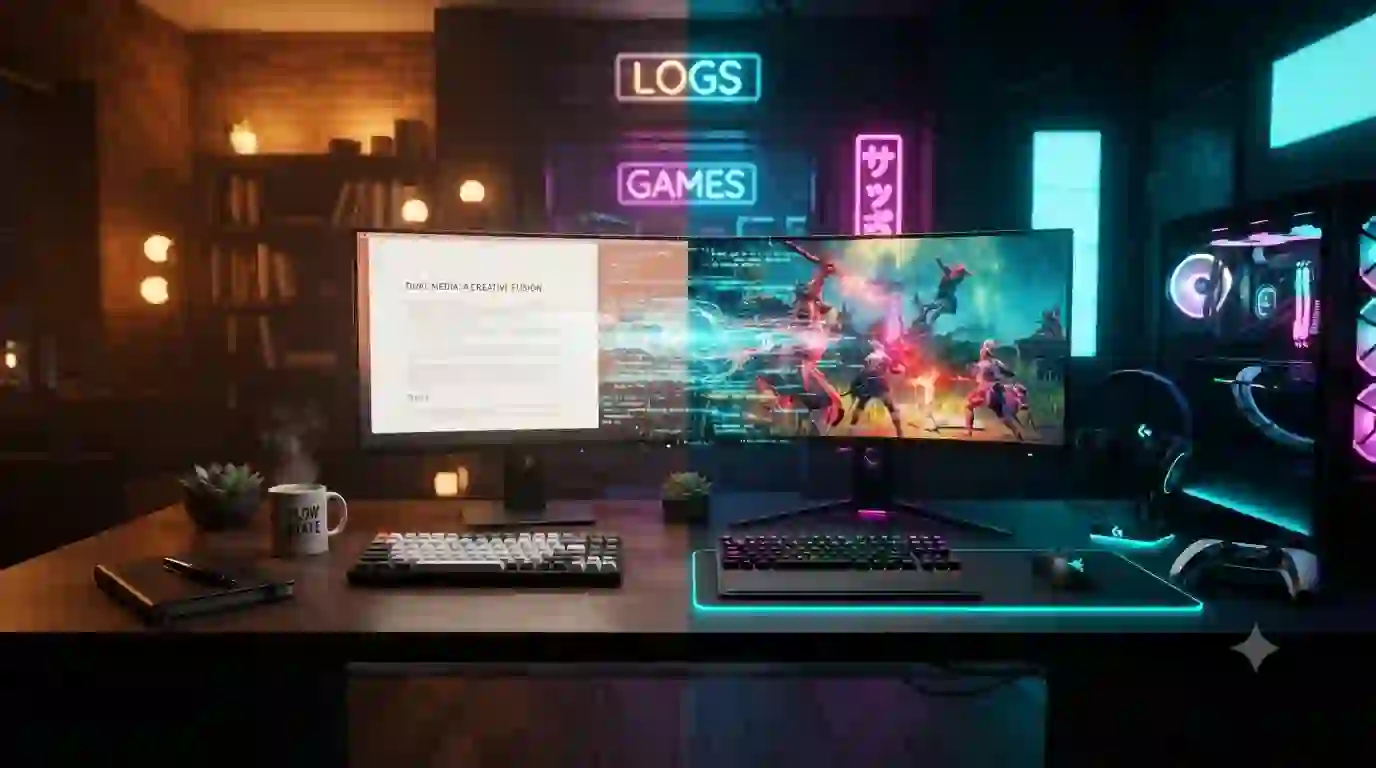
Your equipment does not need to break the bank, but it must support both writing and recording. Comfort and efficiency drive consistency.
- Desk Space: A wide, L-shaped desk allows a monitor for writing and a separate monitor for capture software or chat.
- Keyboard and Mouse: Mechanical keyboards with tactile switches reduce typing fatigue. A high-DPI mouse gives you precision for both editing and gaming.
- Microphone: A dynamic USB mic, like the Shure MV7, captures crisp voiceovers for articles and clear comms for streams.
- Capture Card: An Elgato HD60 S+ lets you record console gameplay directly into your editing timeline.
- Lighting: Softbox lights for your face and RGB strips behind your monitor reduce eye strain and improve video quality.
This setup allows you to switch contexts without reconfiguring your entire space. Write a post, capture a clip, and edit the final piece without moving from your chair.
Essential Software Tools for Seamless Workflow
The right software bridges the gap between your written words and your gaming footage. You do not need a dozen subscriptions; you need a reliable stack.
| Tool Category | Recommended Option | Purpose in Dualmedia |
|---|---|---|
| Writing & Editing | Google Docs / Notion | Drafting articles, creating content calendars, and collaboration. |
| Screen Capture | OBS Studio | Recording gameplay and facecam simultaneously for embedded clips. |
| Video Editing | DaVinci Resolve (Free) | Cutting gameplay highlights and adding text overlays for blog posts. |
| Audio Editing | Audacity | Cleaning up voiceover tracks for tutorials and review narrations. |
| SEO Research | Ahrefs / Semrush | Finding keywords your gaming audience actually types into Google. |
| Scheduling | Buffer / Hootsuite | Sharing your new blog post and gaming clips across social platforms. |
Organize your folders by topic, not by format. Store the draft, the raw footage, and the final exported clips in one folder per article. This keeps your workflow tight and prevents lost files.
Building a Content Strategy That Feeds Both Audiences
Your strategy must answer a single question: What does my audience need right now? A gamer stuck on a boss fight needs a quick strategy. A fan of the lore wants a deep dive into character backstories. Blog gaming dualmedia delivers both.
Create a content matrix:
- Tutorial Guides (Written + Short Clips): Explain a complex mechanic in 800 words and embed a 30-second demonstration.
- Review Roundups (Long-form + Livestream VOD): Publish a detailed review on Tuesday. Stream your first playthrough on Thursday, linking back to the written review.
- News Analysis (Written + Poll/Quiz): Break down a major update and embed a community poll asking readers what they think.
Publish written content on a fixed schedule (e.g., every Tuesday and Thursday). Schedule gaming streams or clips for weekends. This separation gives your audience a rhythm to follow.
SEO Tactics Specific to the Gaming Niche
Gaming is a competitive space. Generic keywords like “FPS tips” are a battlefield. You need specific, high-intent phrases. For blog gaming dualmedia, focus on long-tail questions.
- Target keywords with modifiers: “beginner,” “budget,” “pro settings,” or “patch 2.1.”
- Optimize your video titles and descriptions exactly like your blog posts. YouTube is a search engine too.
- Use schema markup for articles and videos. This helps Google display your content as rich results with thumbnails.
- Build internal links between your written posts and your video pages. If you mention a clip, hyperlink the text so readers can jump directly to the proof.
Your focus keyword, blog gaming dualmedia, appears naturally within your category descriptions and author bio. It should not feel forced. Write for the person searching for how to merge these two passions, not for an algorithm.
Monetizing Your Blog Gaming Dualmedia Platform
A combined audience is a more valuable audience. Creators who can captivate readers and viewers are paid more by advertisers. Do not depend just on one source of money.
- Display Ads: Networks like Mediavine or AdThrive prefer sites with high session depths. Your dual format keeps people clicking around.
- Affiliate Marketing: Link to the specific gear you use in your setup. Write honest reviews and include your affiliate codes for monitors, chairs, and games.
- Premium Memberships: Offer exclusive written guides or uncut gameplay footage for paid subscribers on platforms like Patreon.
- Sponsored Content: Brands love creators who can produce a written review and a sponsored stream. You offer two touchpoints with one agreement.
Diversify early. If one revenue source drops, your other pillars hold steady.
Community Engagement: Turning Viewers Into Loyal Readers
A blog post without comments is a monologue. A stream without chat is a TV show. Blog gaming dualmedia thrives on dialogue. You need to actively bridge the two worlds.
- End each blog post with a question that ties to your next stream. For example, “What build should I try live on Friday?”
- During your stream, read out comments from your previous articles. Mention specific readers by name and thank them.
- Create a Discord server where article updates and stream alerts share the same channel.
People stay for the personality, not just the pixels. When your written voice matches your on-camera energy, your community feels authentic. They trust you because they see you in multiple contexts.
Analytics: Measuring Success Beyond Views
Do not fixate on vanity metrics. A thousand views on a clip mean nothing if those visitors never read your guide. Track engagement depth.
- Time on Page: For articles, aim for over three minutes. This indicates people are reading, not just scanning.
- Click-Through to Video: Measure how many article readers click your embedded clips.
- Chat Activity: High message count during streams shows active participation.
- Returning Visitors: This is your north star metric. Returning visitors indicate that your dualmedia approach is sticky.
Use Google Analytics 4 to set up custom events. Track when a user reads an article and then watches a video in the same session. That is the signature behavior of a successful blog gaming dualmedia strategy.
Overcoming Common Challenges in Dualmedia
Managing two content formats invites burnout. The workload doubles if you are not careful. Protect your time with these habits:
- Batch Production: Write three articles in one day. Record clips for all three on the next day. Edit in a single block.
- Repurpose Content: Turn a popular article into a script for a short-form video. Turn a stream highlight into a “case study” blog post.
- Schedule Rest: Set one full day off each week. Your creativity depends on fresh experiences, not forced output.
Another challenge is audience fragmentation. Some fans only want written guides. Others only want streams. Accept this. Do not try to force everyone into both boxes. Provide excellent content in each format and let your audience choose their entry point. Over time, many will cross over.
Future Trends in Gaming Content and Written Media
The lines between media types are blurring. Artificial intelligence tools now summarize articles and generate clips. Interactive articles that change based on reader choices are emerging.
- AI-Generated Summaries: Use them for your video descriptions, but never for your core analysis. Your unique voice remains your differentiator.
- Interactive Maps and Guides: Embed clickable maps into your RPG guides. Readers can explore while they read.
- Short-Form Integration: Platforms like TikTok and Instagram Reels favor fast-paced clips. Create 15-second hooks that link back to your full article.
Blog gaming dualmedia will evolve, but its foundation remains unchanged: providing genuine help through the best combination of written and visual media. Stay adaptable.
Frequently Asked Questions
1. What exactly is a dualmedia gaming blog?
A dualmedia gaming blog combines long-form written articles (guides, reviews, news) with embedded or linked gaming footage, streams, and interactive elements. It treats text and video as equally important channels for delivering value to the audience.
2. How do I start a gaming blog with a dualmedia approach?
Begin with one pillar guide in your favorite game. Write a comprehensive article. While playing, capture 3–5 short clips that prove your points. Embed those clips in the article. Publish and share both the written link and a short trailer clip on social media.
3. What equipment do I absolutely need for this setup?
A reliable PC or console, a decent USB microphone for clear voice, a capture card if you play on console, and free software like OBS and DaVinci Resolve. Start minimal and upgrade as your revenue grows.
4. How can I get my gaming blog to rank high on Google?
Focus on specific question-based keywords that gamers actually type. Write detailed answers that exceed 1,500 words. Embed your video content to increase dwell time. Build backlinks by guest posting on other gaming sites.
5. Can I make a full-time income from this model?
Yes. Many creators earn sustainable income through a mix of ad revenue, affiliate sales, and sponsored partnerships. The dual format attracts brands looking for deeper integration than a simple video ad offers.
6. How long does it take to see real traction?
Expect three to six months of consistent publishing (2 articles and 1–2 streaming sessions per week) before seeing significant organic traffic. Your first breakthrough often comes from a single well-researched guide that answers an urgent player question.
Your Next Move Starts Today
You possess the strategy, the equipment, and the expertise. The only missing piece is the first step. Do not wait for a perfect setup or a massive audience. Open a document, write a 500-word tip for a game you love, and record a 60-second clip to prove it. Publish both. Answer every comment and chat message you receive.
Blog gaming dualmedia is not a trend. It is a smarter way to build a digital home where every type of fan feels welcome. Your written words earn trust. Your gameplay proves you practice what you preach. That combination is unstoppable.
Ready to build your dualmedia empire? Start by choosing one game, one question, and one piece of footage. Your audience is waiting.