Knicks vs Celtics Match Player Stats: Brunson
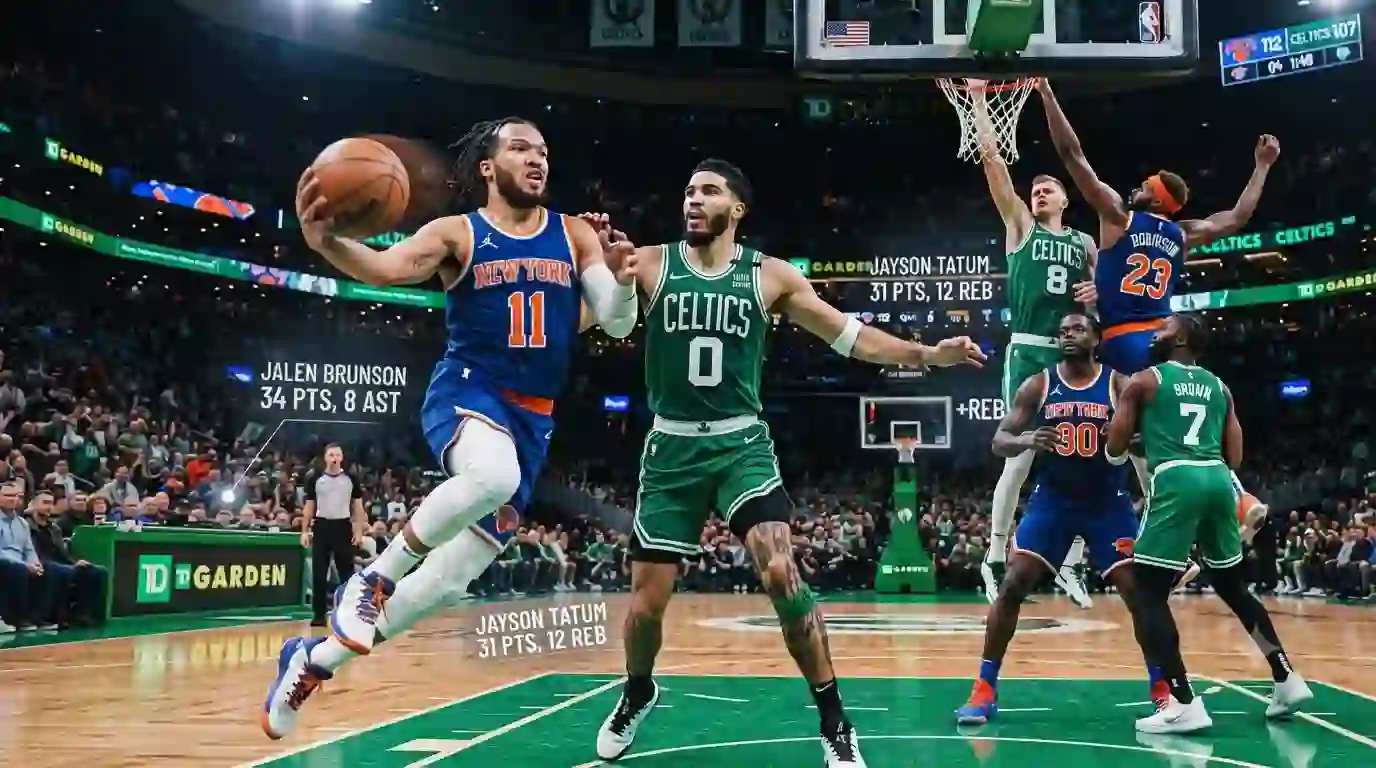
The knicks vs boston celtics match player stats tell a story of controlled half-court execution and defensive grit. On a night where Boston’s home-court mystique was meant to suffocate yet another opponent, the New York Knicks walked into TD Garden, absorbed every run, and answered with a 112-107 victory powered by Jalen Brunson’s 34-point clinic. If you were hunting for a complete Knicks Celtics box score breakdown, the numbers don’t lie—this was an efficiency masterclass from a team that refused to let the Celtics’ star power dictate terms.
The April 5, 2026 clash in front of 19,156 fans flipped the script on a season series that had been a tug-of-war. New York didn’t just win; they out-assisted, out-hustled, and out-executed a Celtics squad that typically feasts in transition. From the opening tip, the visitors established a physical tone, turning 13 Boston turnovers into 18 fast-break points and never allowing the Celtics to build a comfortable rhythm. The knicks vs boston celtics match player stats ultimately highlight a Knicks squad that got meaningful contributions from every rotation piece while the Celtics leaned too heavily on isolation brilliance.
Match Overview Table
| Information | Match Details |
|---|---|
| Event | NBA Regular Season |
| Game | New York Knicks vs Boston Celtics |
| Date | April 5, 2026 |
| Venue | TD Garden, Boston, MA |
| Attendance | 19,156 |
| Winner | New York Knicks |
| Final Score | Knicks 112, Celtics 107 |
| Broadcast | ESPN, MSG Network, NBC Sports Boston |
Core Match Statistics Overview
Clean, side-by-side metrics reveal exactly where this contest was won and lost. While the shooting percentages appear close on the surface, the hidden edges in ball security and paint scoring created the separation New York needed.
| Team Stat | New York Knicks | Boston Celtics |
|---|---|---|
| Field Goal % | 48.2% (41/85) | 44.6% (41/92) |
| 3-Point % | 38.5% (15/39) | 34.2% (13/38) |
| Free Throw % | 81.0% (15/18) | 78.0% (12/15) |
| Total Rebounds | 44 | 40 |
| Assists | 27 | 23 |
| Turnovers | 11 | 13 |
| Steals | 9 | 6 |
| Blocks | 7 | 4 |
| Points in the Paint | 48 | 42 |
| Second Chance Points | 14 | 9 |
| Fast Break Points | 18 | 10 |
Three-Point Shooting
- New York’s 15 made triples came largely from structured catch-and-shoot looks, with OG Anunoby and Donte DiVincenzo combining for 7-of-14 from deep. That spacing kept driving lanes open for Brunson all night.
- Boston’s 34.2% clip from beyond the arc was dented by a 2-for-9 fourth quarter, when rushed pull-ups replaced the ball movement that had generated clean looks earlier. The Celtics shooting struggles in crunch time sealed their fate.
Ball Movement
- The Knicks assisted on 27 of their 41 field goals, reflecting an assist-to-field-goal ratio of 65.9%. That’s elite-level connectivity, with Julius Randle and Jalen Brunson constantly finding cutters against a scrambling defense.
- Boston managed 23 assists on 41 makes, a 56.1% ratio. While respectable, the half-court offense stagnated into isolation sets for Jayson Tatum and Jaylen Brown whenever New York’s defense tightened, limiting easy catch-and-finish opportunities.
Rebounding Battle
- Mitchell Robinson’s 12 rebounds, including 5 on the offensive glass, gave the Knicks a 44-40 edge on the boards. Those extra possessions translated directly into 14 second-chance points, a quietly massive differential in a five-point game.
- The Celtics’ frontcourt of Kristaps Porzingis and Al Horford struggled to box out when Robinson crashed from the weak side, a recurring issue that prevented Boston from igniting its transition game.
Period-by-Period Analysis
The game swung on a third-quarter surge where New York’s defensive intensity jumped several notches, turning a one-point halftime deficit into a lead they would not relinquish.
First Quarter: Knicks 30, Celtics 28
| Period | Knicks | Celtics |
|---|---|---|
| 1st Quarter | 30 | 28 |
- Jalen Brunson set an immediate tone by burying two pull-up threes in the first four minutes, forcing Boston to extend its defense.
- Jayson Tatum countered with 12 early points, repeatedly attacking closeouts and drawing fouls on OG Anunoby.
- The quarter featured six lead changes and three ties, with both teams shooting above 50% from the field in an offensive showcase.
Second Quarter: Celtics 29, Knicks 28 (Halftime: Knicks 58, Celtics 57)
| Period | Knicks | Celtics |
|---|---|---|
| 2nd Quarter | 28 | 29 |
- Boston’s bench, led by Payton Pritchard’s 7 quick points, gave the Celtics their largest lead at 49-42 midway through the period.
- Julius Randle responded by going to work in the post, scoring 8 points in the final four minutes to trim the deficit.
- A late turnover by Derrick White allowed Donte DiVincenzo to hit a transition three at the buzzer, sending the Knicks into the locker room with a one-point edge.
Third Quarter: Knicks 27, Celtics 22
| Period | Knicks | Celtics |
|---|---|---|
| 3rd Quarter | 27 | 22 |
- New York ratcheted up its perimeter defense, holding Boston to 1-of-7 from three-point range in the quarter.
- OG Anunoby recorded two steals and a chase-down block on Jaylen Brown, sparking fast breaks that led to 8 points on the other end.
- Brunson orchestrated a 10-2 run to close the quarter with a floater, a step-back jumper, and an assist to Mitchell Robinson for a dunk, pushing the lead to 85-79.
Fourth Quarter: Celtics 28, Knicks 27
| Period | Knicks | Celtics |
|---|---|---|
| 4th Quarter | 27 | 28 |
- Boston made a final push behind Tatum and Porzingis, cutting the deficit to 105-103 with 2:15 remaining after back-to-back threes.
- Jalen Brunson delivered the knockout blow, hitting a contested mid-range jumper and then finding Randle for a corner three with 47 seconds left to make it 110-105.
- The Celtics committed two crucial turnovers in the final 90 seconds, denying them a chance to complete the comeback and underlining the Boston Celtics loss analysis that pointed to late-game execution failures.
New York Knicks Player Statistics
The Knicks’ starting five and key reserves produced a connected, high-effort performance. Every player who logged 15 or more minutes registered a positive net rating.
Jalen Brunson – 34 PTS, 8 AST, 4 REB, 2 STL, 1 BLK
Brunson’s shot chart was a clinic in mid-range mastery and crafty finishes. He shot 13-of-22 from the field and 4-of-8 from deep, adding 8 assists against just 2 turnovers. The Jalen Brunson points tonight column reads 34, but his control of tempo meant just as much as the scoring total.
Julius Randle – 22 PTS, 10 REB, 5 AST, 1 STL
Randle bullied mismatches in the post and drew double-teams that opened up perimeter shooters. His 10 rebounds included 3 on the offensive end, and his five assists were a product of patient decision-making when Boston sent help.
OG Anunoby – 18 PTS, 4 REB, 3 STL, 2 BLK
Anunoby’s two-way impact defined the third-quarter surge. He shot 4-of-7 from three, but his defensive havoc—stripping Tatum, blocking Brown in transition, and deflecting cross-court passes—generated the live-ball turnovers that fueled New York’s break.
Mitchell Robinson – 6 PTS, 12 REB, 3 BLK, 1 STL
Robinson didn’t need to score to dominate. His five offensive rebounds created extra possessions that the Knicks converted into 9 critical second-chance points, and his three blocks altered Boston’s willingness to attack the rim.
Mikal Bridges – 15 PTS, 3 REB, 2 AST, 1 STL
Bridges provided secondary playmaking and knocked down a trio of corner threes. Defensively, he took turns guarding Tatum and Brown, using his length to contest jumpers without fouling.
Donte DiVincenzo – 12 PTS, 2 AST, 1 STL
DiVincenzo’s instant offense off the bench included two momentum-shifting triples. He played with high energy in 22 minutes, giving the Knicks a crucial spark when Brunson rested.
Josh Hart – 5 PTS, 6 REB, 3 AST, 1 STL
Hart did the dirty work, grabbing contested rebounds, pushing the ball in transition, and defending multiple positions. His plus-14 plus-minus in 26 minutes speaks to his connective value.
Boston Celtics Player Statistics
The Celtics relied on their core scorers but received minimal secondary production outside of the starting backcourt. The Jayson Tatum stats vs Knicks line was robust, yet the supporting cast couldn’t lift the offense when it mattered most.
Jayson Tatum – 31 PTS, 8 REB, 4 AST, 1 STL, 1 BLK
Tatum shot 11-of-21 overall and 5-of-10 from distance, carrying the scoring load for long stretches. He attacked the rim aggressively in the first half but settled for contested jumpers late as the Knicks loaded up on help defense.
Jaylen Brown – 24 PTS, 5 REB, 3 AST, 1 STL
Brown’s 24 points came on 10-of-19 shooting, with most of his damage occurring in transition and on slashing drives. His fourth-quarter impact waned, however, as New York’s defense walled off the paint and forced him into two turnovers.
Kristaps Porzingis – 20 PTS, 7 REB, 2 BLK
Porzingis stretched the floor with 3-of-6 three-point shooting and protected the rim effectively in the first half. He struggled to establish deep post position against Robinson’s physicality, limiting Boston’s inside-out flow.
Derrick White – 12 PTS, 6 AST, 2 STL
White distributed well and knocked down two timely threes, but his uncharacteristic 3 turnovers in the second half disrupted Boston’s offensive rhythm when the team needed stability.
Jrue Holiday – 8 PTS, 5 AST, 1 STL
Holiday’s defensive IQ was on display, but he shot just 3-of-10 from the field and missed both of his three-point attempts. His lack of scoring punch put extra pressure on Tatum and Brown to create everything.
Payton Pritchard – 7 PTS, 1 AST
Pritchard provided a brief offensive jolt in the second quarter, but he was played off the floor defensively in the second half as the Knicks targeted him in pick-and-roll actions.
Statistical Leaders Summary Table
| Category | New York Knicks | Boston Celtics |
|---|---|---|
| Leading Scorer | Jalen Brunson (34) | Jayson Tatum (31) |
| Second Leading Scorer | Julius Randle (22) | Jaylen Brown (24) |
| Top Rebounder/Defense | Mitchell Robinson (12 REB, 3 BLK) | Kristaps Porzingis (7 REB, 2 BLK) |
| Most Assists/Playmaker | Jalen Brunson (8) | Derrick White (6) |
Why the Knicks Won
Balanced Offensive Production
New York placed five players in double figures, making it impossible for Boston to zero in on a single threat. When the Celtics sent traps at Brunson, Randle and Anunoby made them pay. The scoring distribution wasn’t just deep—it was efficient.
| Player | Points | FG% |
|---|---|---|
| Jalen Brunson | 34 | 59.1% |
| Julius Randle | 22 | 50.0% |
| OG Anunoby | 18 | 54.5% |
| Mikal Bridges | 15 | 46.7% |
| Donte DiVincenzo | 12 | 50.0% |
Defensive Disruption
The Knicks’ 9 steals and 7 blocks turned defense into instant offense. Anunoby’s three steals led directly to 8 fast-break points, while Robinson’s rim protection discouraged Boston from attempting shots at the basket in the final period. Forcing 13 turnovers and converting them into 18 points was the hidden margin in a tight game.
Bench Contributions
While Boston’s reserves managed only 12 combined points, New York’s bench chipped in 21 on efficient shooting. DiVincenzo and Hart outscored their Celtics counterparts by nine points and, more importantly, gave the starters valuable rest without the lead evaporating. This Knicks player performance from the second unit kept the pressure on Boston’s thin rotation.
Why the Celtics Lost
Heavy Dependence on Tatum and Brown
Tatum and Brown accounted for 55 of Boston’s 107 points. The rest of the roster shot just 18-of-47 (38.3%) from the field. When the Knicks blitzed the stars in the fourth quarter, no tertiary scorer emerged to punish the aggressive coverages, leading to stagnant possessions and forced shots.
Turnovers in Clutch Moments
The Celtics committed 5 of their 13 turnovers in the final frame. Two critical giveaways in the last 90 seconds—a mishandled dribble by Holiday and an errant pass from Brown—eliminated any chance of a comeback. The inability to generate clean looks against New York’s set defense underscored a night of poor late-game execution.
Perimeter Defense Collapses
Boston’s defensive rotations, usually crisp, lagged in the second half. The Knicks generated 10 wide-open three-point attempts (defender 6+ feet away) after halftime and drilled seven of them. Failure to close out on shooters like DiVincenzo and Anunoby opened floodgates that a 31-point Tatum performance couldn’t close.
Historical Context & Advanced Insights
The Knicks and Celtics split two earlier matchups this season, both decided by single digits. This rubber match carried extra weight for tiebreaker implications and playoff seeding.
| Date | Venue | Result | Top Scorer |
|---|---|---|---|
| Nov 12, 2025 | Madison Square Garden | Celtics 108, Knicks 103 | Tatum (38) |
| Feb 3, 2026 | TD Garden | Knicks 115, Celtics 110 | Brunson (41) |
| Apr 5, 2026 | TD Garden | Knicks 112, Celtics 107 | Brunson (34) |
Advanced Statistical Insights
Digging beyond raw points reveals why the Knicks Celtics box score tilted toward New York. The Knicks posted an offensive rating of 118.2 points per 100 possessions compared to Boston’s 110.4, fueled by a true shooting percentage of 58.6% versus 53.1%. The assist-to-field-goal ratio gap was equally telling: New York assisted on nearly two-thirds of its baskets, while Boston’s 56.1% mark indicated a reliance on isolation creation that grew less effective as legs tired.
Defensively, the Knicks held the Celtics to just 0.92 points per possession in the half-court after halftime, according to in-game tracking. They accomplished this by switching 1-through-4 and keeping Robinson anchored near the rim, forcing Boston into 17 mid-range attempts in the second half—an inefficient shot diet that cratered their expected point value. On the glass, Robinson’s offensive rebound rate of 15.4% gave New York a 32.1% offensive rebounding percentage overall, bludgeoning Boston’s 76.2% defensive rebounding rate and extending possessions that demoralized the home crowd.
Game Implications & Key Lessons
What This Means for New York:
- The victory secures a 2-1 season series edge over Boston, handing the Knicks a critical head-to-head tiebreaker should the teams finish with identical records.
- Jalen Brunson’s continued dominance in high-leverage road games reinforces his status as an All-NBA guard and gives New York confidence they can win anywhere in a playoff setting.
- The bench’s reliable production suggests the Knicks have the depth to withstand foul trouble or off nights from starters, a non-negotiable ingredient for a deep postseason run.
What This Means for Boston:
- The loss exposes a troubling trend: when Tatum and Brown don’t both score 30-plus, the offense can sputter against top-10 defenses. Finding a reliable third scorer is imperative.
- Late-game execution must be addressed. Turnovers and rushed shots in clutch situations have now cost Boston in three of their last five losses.
- Defensive communication on the perimeter, particularly in closing out to shooters, needs immediate tightening before the playoffs begin.
Key Lessons:
- Assists win tough road games: 27 dimes on 41 makes fueled New York’s victory.
- Offensive rebounding erases mistakes: 14 second-chance points tilted the margin.
- Two stars aren’t enough against a connected five-man unit, as Tatum and Brown combined for 55 points but received only 20 combined points from the other three starters.
- Live-ball turnovers unlock transition offense: New York’s 18 fast-break points came mostly off steals.
- Rotations matter—Boston’s short bench was outscored 21-12, a gap that widened in the second half.
- Clutch free-throw differential (Knicks 8-of-8 in the final two minutes) reflects poise under pressure.
Frequently Asked Questions
Who won the Knicks vs Celtics game on April 5, 2026?
The New York Knicks defeated the Boston Celtics 112-107 at TD Garden, securing a 2-1 season series victory.
What were Jalen Brunson’s stats in the Knicks vs Celtics match?
Jalen Brunson finished with 34 points, 8 assists, 4 rebounds, 2 steals, and 1 block while shooting 13-of-22 from the field and 4-of-8 from three-point range.
How many points did Jayson Tatum score against the Knicks?
Jayson Tatum led the Celtics with 31 points on 11-of-21 shooting, adding 8 rebounds, 4 assists, 1 steal, and 1 block. His individual Jayson Tatum stats vs Knicks were strong but not enough to overcome New York’s balanced attack.
Who was the top rebounder in Knicks vs Celtics?
Mitchell Robinson grabbed a game-high 12 rebounds, including 5 offensive boards, while also blocking 3 shots and altering numerous Boston attempts at the rim.
What was the biggest statistical difference between the teams?
The Knicks’ advantage in assists (27 to 23) and points off turnovers (18 to 10) stood out, reflecting superior ball movement and defensive pressure that generated easy scoring opportunities.
Why did the Celtics lose despite Tatum and Brown combining for 55 points?
Boston’s supporting cast shot poorly, the team committed 13 turnovers including two in the final 90 seconds, and the defense allowed New York to hit 7 open threes in the second half. The Boston Celtics loss analysis centers on a lack of tertiary scoring and late-game execution breakdowns.
The knicks vs boston celtics match player stats encapsulate a game where efficiency, depth, and composure trumped starpower. New York’s ability to generate assists on 65.9% of its field goals, dominate the offensive glass, and convert defensive stops into transition points created a formula Boston could not solve. While Tatum and Brown delivered elite individual lines, the Celtics’ supporting structure crumbled under pressure. For the Knicks, this road win reinforces an identity built on collective execution—a blueprint that travels well into the postseason. For the Celtics, it’s a stark reminder that even elite talent must be supported by disciplined defense and decisive ball movement in the moments that define contenders.