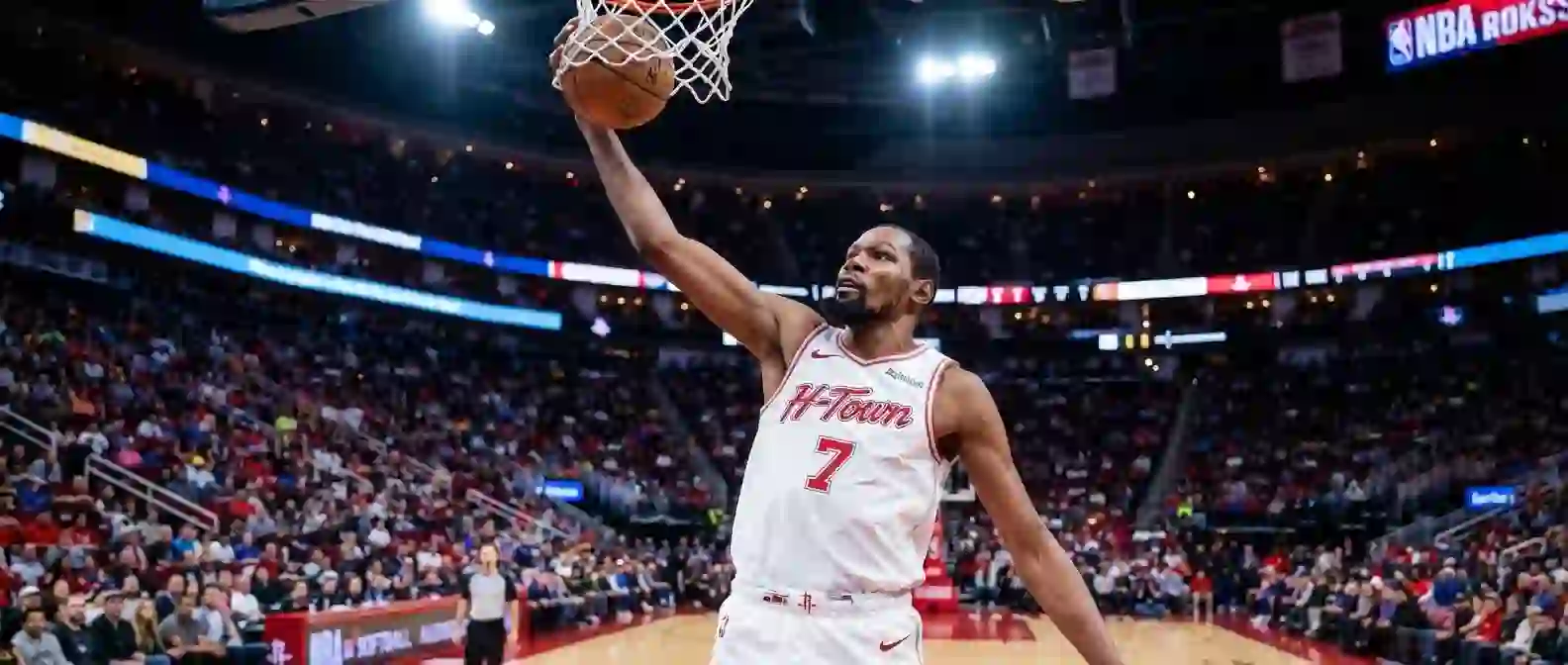
Kevin Durant Biography and Stats: Leads Rockets to 117-116 Victory
Raw point totals can hide who actually controlled a one-possession game. Kevin Durant turned Houston’s visit to Golden State into a sharp example: scoring alone did not explain his influence, yet the 117-116 margin leaves no room for lazy interpretation. The answer is in his efficiency, playmaking, rim protection and final assist, backed by a full Rockets vs Warriors player stats breakdown.
Kevin Durant Biography
| Biography Detail | Kevin Durant Profile |
|---|---|
| Full name | Kevin Wayne Durant |
| Born | September 29, 1988 |
| Age on game date | 37 |
| Birthplace | Washington, D.C., United States |
| Height | 6 feet 11 inches (211 cm) |
| Weight | 240 pounds (109 kg) |
| Position | Small forward / power forward |
| Shoots | Right |
| Team | Houston Rockets |
| Jersey number | 7 |
| College | Texas |
| NBA Draft | 2007, Round 1, No. 2 overall by the Seattle SuperSonics |
| NBA debut | October 31, 2007 |
| NBA championships | 2 (2017, 2018) |
| NBA Finals MVP awards | 2 (2017, 2018) |
| NBA Most Valuable Player | 2013-14 |
| Scoring titles | 4 |
Durant’s profile information and major honors are consistent with his Basketball-Reference player record, which lists him at 6-foot-11 and 240 pounds, drafted second overall in 2007 after one college season at Texas 3.
On April 5, 2026, Kevin Durant produced 31 points, eight rebounds, eight assists and three blocks as the Houston Rockets beat the Golden State Warriors 117-116 at Chase Center in San Francisco. The NBA regular-season game drew 18,064 spectators, and the attendance, officials and 2:23 game time are recorded in the official box-score archive 8.
Houston won through shot quality, frontcourt balance and one composed late possession. Golden State erased a 10-point deficit by scoring 34 in the fourth quarter, but Durant responded to Gary Payton II’s go-ahead basket by feeding Alperen Şengün for the winning layup with 11 seconds left. Stephen Curry’s final three-point attempt missed, leaving Houston with its second road win over Golden State in the 2025-26 season 2.
Houston Rockets vs Golden State Warriors Match Overview
| Information | Match Details |
|---|---|
| Event | 2025-26 NBA Regular Season |
| Game | Houston Rockets vs Golden State Warriors |
| Date | April 5, 2026 |
| Venue | Chase Center, San Francisco, California |
| Attendance | 18,064 |
| Winner | Houston Rockets |
| Final Score | Rockets 117, Warriors 116 |
| Broadcast | NBC and Peacock |
NBC and Peacock carried the game as part of Sunday Night Basketball, with the national broadcast scheduled for 10 p.m. ET 9.
Rockets vs Warriors Player Stats: Core Team Comparison
| Team Metric | Houston Rockets | Golden State Warriors | Statistical Edge |
|---|---|---|---|
| Field goals | 44-80 | 42-84 | Houston |
| Field-goal percentage | 55.0% | 50.0% | Houston +5.0 pts |
| Three-pointers | 13-29 | 14-40 | Golden State in makes; Houston in accuracy |
| Three-point percentage | 44.8% | 35.0% | Houston +9.8 pts |
| Free throws | 16-19 | 18-20 | Golden State |
| Free-throw percentage | 84.2% | 90.0% | Golden State +5.8 pts |
| Offensive rebounds | 8 | 6 | Houston +2 |
| Total rebounds | 38 | 31 | Houston +7 |
| Assists | 30 | 34 | Golden State +4 |
| Turnovers | 14 | 10 | Golden State -4 |
| Steals | 4 | 7 | Golden State +3 |
| Blocks | 7 | 3 | Houston +4 |
| Effective field-goal percentage | 63.1% | 58.3% | Houston +4.8 pts |
| True-shooting percentage | 66.2% | 62.5% | Houston +3.7 pts |
| Offensive rating | 125.3 | 124.2 | Houston +1.1 |
Kevin Durant Game Stats Drove Shooting Efficiency
- The Kevin Durant stats line included 10-of-17 shooting, 3-of-6 from three and 8-of-9 at the line, producing a game-high 31 points on 74.0% true shooting.
- Houston needed four fewer field-goal attempts than Golden State to make two more shots, a compact summary of why the Rockets’ 55.0% accuracy mattered more than Golden State’s extra possessions.
Three-Point Shooting Separated the Offenses
- Golden State made one more three, but needed 11 additional attempts. Houston’s 13-of-29 line generated 1.34 points per three-point attempt, compared with 1.05 for the Warriors.
- The Rockets hit 10 of their final 24 threes after going 1-of-5 in the first quarter. That correction powered the 29-22 second period and the 37-29 third.
Ball Movement Stayed Elite on Both Sides
- Golden State assisted 34 of 42 field goals, an 81.0% assist-to-field-goal rate. Draymond Green supplied 12 assists, while Stephen Curry added four in just over 26 minutes.
- Houston recorded 30 assists on 44 makes. Kevin Durant assists accounted for eight, and Şengün and Amen Thompson added seven each, giving the Rockets three different initiation points.
Rebounding and Rim Protection Favored Houston
- The Rockets won the total-rebound count 38-31 and blocked seven shots. The Kevin Durant rebounds total reached eight, all defensive, while Jabari Smith Jr. led Houston with nine boards.
- Houston’s 24.2% offensive-rebound rate beat Golden State’s 16.7%, limiting the damage from the Rockets’ four-turnover disadvantage.
Period-by-Period Analysis
First Quarter: Warriors 31, Rockets 26
| First Quarter | Houston Rockets | Golden State Warriors |
|---|---|---|
| Points | 26 | 31 |
| Field goals | 12-20 | 12-23 |
| Three-pointers | 1-5 | 6-14 |
| Assists | 8 | 11 |
| Turnovers | 3 | 3 |
- Golden State opened with a 7-0 run, using a Draymond Green three after two early cuts to force Houston into immediate recovery mode.
- Houston shot 60.0% from the floor, but the Warriors’ six threes created a 15-point advantage from beyond the arc during the period.
- Durant played all 12 minutes and posted six points, two rebounds, three assists and a block without a turnover, keeping the five-point deficit manageable.
Second Quarter: Rockets 29, Warriors 22
| Second Quarter | Houston Rockets | Golden State Warriors |
|---|---|---|
| Points | 29 | 22 |
| Field goals | 11-23 | 7-18 |
| Three-pointers | 5-10 | 1-7 |
| Rebounds | 12 | 5 |
| Halftime score | 55 | 53 |
- Houston reversed the perimeter battle by hitting five threes while holding Golden State to 1-of-7 from deep.
- Jabari Smith Jr. scored nine points in the quarter and made three of four three-point attempts, stretching Golden State’s defense away from Şengün’s interior touches.
- The Rockets turned a five-point first-quarter deficit into a two-point halftime lead, even though Durant scored six points and did not record an assist in the period.
Third Quarter: Rockets 37, Warriors 29
| Third Quarter | Houston Rockets | Golden State Warriors |
|---|---|---|
| Points | 37 | 29 |
| Field goals | 13-20 | 10-20 |
| Three-pointers | 5-9 | 1-6 |
| Assists | 11 | 7 |
| Score after three | 92 | 82 |
- Durant took control with 16 points on 4-of-5 shooting, two threes, six free throws, four rebounds, two assists and two blocks in the quarter.
- Houston produced 11 assists on 13 made baskets and shot 65.0%, turning half-court possessions into direct attempts before Golden State could load up on Durant.
- Amen Thompson went 3-for-3 and Smith went 3-for-3, so Golden State could not solve the central problem by sending a second defender only at Durant.
Stephen Curry Stats Powered a Fourth-Quarter Rally
| Fourth Quarter | Houston Rockets | Golden State Warriors |
|---|---|---|
| Points | 25 | 34 |
| Field goals | 8-17 | 13-23 |
| Three-pointers | 2-5 | 6-13 |
| Assists | 6 | 11 |
| Turnovers | 3 | 0 |
- Golden State played a turnover-free quarter, hit six threes and won the period by nine. Curry and Payton combined for 16 points, while Curry’s late layup and three kept the comeback alive.
- Houston’s offense slowed, but Şengün scored seven points and Durant delivered three assists in 6:56, preserving enough half-court creation to survive.
- Payton’s basket put Golden State ahead with 20 seconds left. Durant then drew attention and passed to Şengün for a cutting layup at 0:11 before Curry missed the final long three.
Houston Rockets Player Statistics
| Player | MIN | PTS | REB | AST | STL | BLK | FG | 3PT | FT | +/- |
|---|---|---|---|---|---|---|---|---|---|---|
| Kevin Durant | 37:15 | 31 | 8 | 8 | 0 | 3 | 10-17 | 3-6 | 8-9 | -4 |
| Alperen Şengün | 36:54 | 24 | 6 | 7 | 0 | 2 | 10-19 | 1-5 | 3-3 | -1 |
| Jabari Smith Jr. | 31:37 | 23 | 9 | 1 | 0 | 0 | 9-12 | 5-7 | 0-0 | +15 |
| Amen Thompson | 39:29 | 18 | 3 | 7 | 1 | 0 | 8-11 | 0-0 | 2-4 | +2 |
Kevin Durant: 31 Points, Eight Rebounds and Eight Assists
Durant’s 31-8-8 line was built on selective aggression rather than forced volume. He scored 19 second-half points, blocked three shots and made the read that decided the game, giving Houston an answer as Golden State sent attention toward him late.
His 28.6 Game Score led every player, and his 141 individual offensive rating reflected the value of combining 58.8% field-goal shooting with eight assists. The three turnovers were controlled relative to a 30.2% usage rate and 37 minutes as a primary initiator.
Alperen Şengün: 24 Points and the Winning Finish
Şengün scored 24 on 10-of-19 shooting, added six rebounds, seven assists and two blocks, and committed only two turnovers. His interior decision-making prevented the Warriors from treating Durant’s touches as isolated scoring possessions.
The final layup completed the partnership: Durant attracted the defense, Şengün timed his cut, and Houston converted before Golden State could reset. He also made all three free throws, valuable in a game decided by one point.
Jabari Smith Jr.: Elite Floor Spacing and Nine Rebounds
Smith delivered 23 points on 9-of-12 shooting and made five of seven threes, a 71.4% conversion rate. His spacing punished help from the strong side and created wider driving and post-entry lanes for Thompson and Şengün.
His nine defensive rebounds were a team high, and Houston outscored Golden State by 15 during his 31:37. That plus-minus led the game and captured how well his low-turnover scoring fit the starting unit.
Amen Thompson: Efficient Connector
Thompson scored 18 points on 8-of-11 shooting and distributed seven assists against two turnovers. He did not attempt a three, yet his cutting, transition speed and interior finishing kept his 70.5% true-shooting performance highly efficient.
His late goaltend briefly gave Golden State the lead, but it did not erase 39 minutes of productive two-way work. Thompson helped Houston move from its first option into secondary actions without stalling the possession.
Golden State Warriors Player Statistics
| Player | MIN | PTS | REB | AST | STL | BLK | FG | 3PT | FT | +/- |
|---|---|---|---|---|---|---|---|---|---|---|
| Stephen Curry | 26:08 | 29 | 2 | 4 | 1 | 0 | 11-21 | 5-10 | 2-3 | +12 |
| Brandin Podziemski | 36:50 | 18 | 2 | 3 | 1 | 0 | 7-11 | 2-6 | 2-2 | -2 |
| Gary Payton II | 25:20 | 14 | 3 | 2 | 0 | 0 | 6-11 | 0-3 | 2-2 | -3 |
| Draymond Green | 34:03 | 7 | 6 | 12 | 1 | 0 | 3-4 | 1-1 | 0-0 | +6 |
Stephen Curry: 29 Points in 26 Minutes
Curry returned after missing 27 consecutive games with a right knee injury and scored 29 points on 11-of-21 shooting. He made five of 10 threes, had a 65.0% true-shooting rate and finished plus-12, an unusually productive return under a managed workload.
He supplied 19 second-half points and eight in the fourth quarter, including a late three immediately after Şengün’s three-point play. His final attempt was difficult and long, but Golden State would not have reached that winning opportunity without his shot creation.
Brandin Podziemski: Efficient Secondary Scoring
Podziemski scored 18 points on 7-of-11 shooting and added three assists. He converted cuts and spot-up opportunities well, though his 2-of-6 three-point line left some value on the table in a one-point result.
His two rebounds were modest for 36:50, which contributed to Houston’s frontcourt edge. Still, a 75.8% true-shooting rate made him Golden State’s most efficient higher-volume scorer outside Curry.
Gary Payton II: Fourth-Quarter Pressure
Payton scored 14 points, including eight in the fourth quarter, and briefly put Golden State ahead with 20 seconds left. His cuts attacked Houston’s ball-watching and gave Green a direct passing target in the lane.
He missed all three three-point attempts but shot 6-of-8 inside the arc. That contrast explains his impact: he was most dangerous moving behind the defense, not spacing beyond it.
Draymond Green: 12-Assist Control
Green produced 12 assists, six rebounds, seven points and only one turnover. Golden State assisted 81.0% of its field goals largely because Green kept finding cutters and moving the ball into Curry’s advantage situations.
His five fouls reduced his defensive freedom, and Houston’s frontcourt still shot efficiently around him. The playmaking was excellent; the team defense behind aggressive help could not lower Houston’s effective field-goal rate enough.
Durant vs Curry Statistical Leaders Summary
| Category | Houston Rockets | Golden State Warriors |
|---|---|---|
| Leading Scorer | Kevin Durant (31) | Stephen Curry (29) |
| Second Leading Scorer | Alperen Şengün (24) | Brandin Podziemski (18) |
| Top Rebounder/Defense | Jabari Smith Jr. (9 REB) | Kristaps Porziņģis (8 REB) |
| Most Assists/Playmaker | Kevin Durant (8 AST) | Draymond Green (12 AST) |
Durant also tied for Houston’s assist lead with eight, while Şengün and Thompson finished one behind. Golden State’s defensive rebounding leader was Porziņģis with six; his eight total boards topped the Warriors.
Why the Houston Rockets Won
Superior Shot Conversion
| Efficiency Metric | Rockets | Warriors | Houston Margin |
|---|---|---|---|
| FG% | 55.0% | 50.0% | +5.0 pts |
| 3PT% | 44.8% | 35.0% | +9.8 pts |
| eFG% | 63.1% | 58.3% | +4.8 pts |
| True-shooting % | 66.2% | 62.5% | +3.7 pts |
Houston’s clearest advantage was not shot volume but return per attempt. The Rockets scored 117 points from 80 field-goal attempts, while Golden State needed 84 attempts for 116, and Houston’s effective field-goal percentage captured the added value of its 13 threes.
This edge also explains why Golden State’s better turnover and free-throw numbers were not enough. Houston could lose several possession events because each completed shooting possession was more productive.
Balanced Offensive Production
| Rockets Scorer | Points | FG% | True-Shooting % |
|---|---|---|---|
| Kevin Durant | 31 | 58.8% | 74.0% |
| Alperen Şengün | 24 | 52.6% | 59.1% |
| Jabari Smith Jr. | 23 | 75.0% | 95.8% |
| Amen Thompson | 18 | 72.7% | 70.5% |
Houston’s top four combined for 96 points, or 82.1% of the team total. More important, each player scored through a different route: Durant from all three levels, Şengün through interior creation, Smith through spacing and Thompson through cuts and drives.
That variety made the Rockets hard to scheme against. A second defender sent at Durant could release Şengün as a passer or Smith as a shooter, while switching smaller defenders created a new interior mismatch.
Frontcourt Control
| Interior Metric | Rockets | Warriors | Edge |
|---|---|---|---|
| Total rebounds | 38 | 31 | Houston +7 |
| Offensive rebounds | 8 | 6 | Houston +2 |
| Offensive-rebound rate | 24.2% | 16.7% | Houston +7.5 pts |
| Blocks | 7 | 3 | Houston +4 |
Houston’s seven-rebound advantage shortened Golden State’s chances to build a lead from its turnover edge. Smith and Durant combined for 17 defensive boards, while Durant, Şengün and Reed Sheppard combined for six of the team’s seven blocks.
The block count did more than erase shots. It made the Warriors consider extra passes near the rim, helping Houston recover after initial penetration and push some possessions toward late-clock attempts.
Durant’s Late-Game Decision Quality
| Durant Metric | Value |
|---|---|
| Points | 31 |
| Assists | 8 |
| Turnovers | 3 |
| Assist-to-turnover ratio | 2.67 |
| True-shooting percentage | 74.0% |
| Individual offensive rating | 141 |
Durant did not force the final shot after Payton put Golden State in front. He read the help, trusted Şengün’s cut and delivered the pass for the highest-value attempt available—a layup with 11 seconds left.
That decision matched the rest of his night. His eight assists created at least 16 additional points, meaning his scoring and passing directly produced no fewer than 47 of Houston’s 117 points.
Why the Golden State Warriors Lost
Too Many Low-Value Three-Point Attempts
| Perimeter Metric | Warriors | Rockets |
|---|---|---|
| Three-point attempts | 40 | 29 |
| Three-point makes | 14 | 13 |
| Three-point percentage | 35.0% | 44.8% |
| Points per three-point attempt | 1.05 | 1.34 |
Golden State’s 11 additional attempts yielded only one additional make. Gui Santos went 2-of-8, Payton went 0-of-3 and Porziņģis went 0-of-3, so Curry’s 5-of-10 performance could not pull the collective rate above Houston’s.
The issue was not simply taking threes. It was that too many came from lower-efficiency shooters or after Houston had recovered, while the Rockets generated cleaner catch-and-shoot chances for Smith, Durant and Sheppard.
The Third-Quarter Defensive Breakdown
| Third-Quarter Metric | Rockets | Warriors |
|---|---|---|
| Points | 37 | 29 |
| FG% | 65.0% | 50.0% |
| 3PT% | 55.6% | 16.7% |
| Assists | 11 | 7 |
Allowing 37 points created the 10-point hole that Golden State spent the fourth quarter repairing. The Warriors could not contain the initial action or the next pass, and Houston’s 11 assists showed that the damage came through connected execution, not a string of isolated jumpers.
Durant scored 16 in the quarter, yet Houston’s support made the coverage choice impossible. Thompson and Smith combined to shoot 6-for-6, removing the option of loading every defender toward Durant.
Heavy Dependence on Curry’s Comeback Minutes
| Warriors Split | Value |
|---|---|
| Curry minutes | 26:08 |
| Curry points | 29 |
| Curry plus/minus | +12 |
| Team margin in non-Curry minutes | -13 |
Curry was outstanding, but the Warriors lost the minutes around his controlled return workload by 13 points. His 41.7% usage rate placed an enormous scoring burden on a player appearing for the first time in more than two months.
Golden State’s 34 assists suggest good passing across the lineup, but creation and finishing were not the same thing. The starters other than Podziemski shot 13-of-32, leaving the offense dependent on Curry’s reserve shotmaking and Payton’s cuts.
Historical Context and Advanced Insights
2025-26 Rockets vs Warriors Season Series Breakdown
| Date | Venue | Result | Season-Series Position |
|---|---|---|---|
| November 26, 2025 | Chase Center | Rockets 104, Warriors 100 | Houston led 1-0 |
| March 5, 2026 | Houston | Warriors 115, Rockets 113 (OT) | Series tied 1-1 |
| April 5, 2026 | Chase Center | Rockets 117, Warriors 116 | Houston won series 2-1 |
Houston finished the regular-season series 2-1 and won both games at Chase Center. The three-game list and scores are documented in the 2025-26 Rockets season-series record 1.
The combined margin across all three games was only three points in Houston’s favor: the Rockets scored 334, and the Warriors scored 331. Two Houston wins by four and one points outweighed Golden State’s two-point overtime victory, showing how narrow the matchup remained across different lineups and game states.
Advanced Statistical Insights: Efficiency Beat Possession Security
| Advanced Metric | Houston | Golden State |
|---|---|---|
| Estimated pace | 93.4 | 93.4 |
| Offensive rating | 125.3 | 124.2 |
| Effective FG% | 63.1% | 58.3% |
| Turnover rate | 13.7% | 9.7% |
| Offensive-rebound rate | 24.2% | 16.7% |
| FT per FGA | .200 | .214 |
| Assist-to-FG ratio | 68.2% | 81.0% |
This game is a useful warning against treating one possession metric as the complete explanation. Golden State protected the ball better, assisted a higher share of makes and generated a slightly higher free-throw rate. Under many conditions, that combination should support a win.
Houston changed the equation through effective field-goal percentage. Its 4.8-point eFG advantage was large enough to overcome four extra turnovers because the Rockets turned each field-goal attempt into approximately 1.46 total points, compared with 1.38 for Golden State. That calculation includes points added at the line, so it reflects the total scoreboard return associated with each field-goal attempt rather than shot value alone.
The offensive-rebound rate supplied a second counterweight. Houston recovered 24.2% of its available offensive rebounds, 7.5 percentage points above Golden State. Those extra chances did not appear as a huge raw gap—only two offensive rebounds—but in a one-point game even one retained possession can cancel the cost of a turnover.
Durant’s individual efficiency sits at the center of the analysis. His 74.0% true-shooting rate exceeded Golden State’s team rate by 11.5 percentage points, while his 67.6% effective field-goal rate remained high before free throws were counted. Add a 2.67 assist-to-turnover ratio and three blocks, and his impact reached scoring, creation and shot prevention.
Golden State’s 81.0% assist rate deserves context as well. A high assisted share shows connected offense, but it does not guarantee efficient finishing. The Warriors assisted four more baskets than Houston while making two fewer field goals, because the Rockets converted more of the looks their passing created.
Game Implications and Key Lessons
What This Means for the Houston Rockets
- Houston improved to 49-29 and added a high-pressure road win in a venue where it had already won earlier in the season.
- The Kevin Durant points total mattered, but the broader gain was confirmation that Durant, Şengün and Thompson could share playmaking work without reducing Smith’s value as a floor spacer.
- Winning despite a nine-point fourth-quarter swing gave the Rockets a useful late-game reference: attract help, keep the weak-side action moving and choose the cleanest finish instead of the most dramatic shot.
What This Means for the Golden State Warriors
- Curry’s 29 points in 26:08 offered a major positive after a 27-game absence, though the team still needed better production in the minutes he sat.
- The defense must reduce opponent shooting at the source. Forcing 14 turnovers did not compensate for allowing 55.0% from the floor and 44.8% from three.
- Golden State’s secondary shooters need either cleaner attempts or a stronger balance between perimeter volume and rim pressure; 30 non-Curry three-point attempts produced only nine makes.
Key Lessons From the Match
- Efficiency can outweigh possession count: Houston won despite four more turnovers because its eFG% was 4.8 percentage points better.
- Kevin Durant assists changed the final possession: the winning play came from a pass, not an isolation jumper.
- Balanced scoring limits aggressive help: four Rockets scored at least 18, making one-player coverage schemes ineffective.
- Quarter-level three-point variance shapes momentum: Golden State won the first-quarter arc battle 6-1, while Houston answered 10-2 across the next two quarters.
- Rebounding has late-game value: the Rockets’ 38-31 edge reduced Golden State’s chance to build from Houston mistakes.
- A star’s return does not solve every lineup issue: Curry excelled, but Golden State lost his bench minutes by 13 points.
Frequently Asked Questions
Who won the Houston Rockets vs Golden State Warriors game?
The Houston Rockets won 117-116 at Chase Center on April 5, 2026. Şengün scored the winning layup from Durant’s pass with 11 seconds remaining.
What were Kevin Durant’s stats against the Warriors?
Kevin Durant recorded 31 points, eight rebounds, eight assists and three blocks in 37:15. He shot 10-of-17 from the field, 3-of-6 from three and 8-of-9 at the free-throw line.
Who scored the most points in Rockets vs Warriors?
Durant led all scorers with 31 points. Curry led Golden State with 29 in his return from a right knee injury.
What were Stephen Curry’s stats in his return?
Curry scored 29 points with two rebounds, four assists and one steal in 26:08. He shot 11-of-21 overall and made five of 10 three-point attempts.
Who made the game-winning basket?
Alperen Şengün made the go-ahead cutting layup with 11 seconds left. Durant supplied his eighth assist on the play.
Why did the Rockets beat the Warriors?
Houston shot 55.0% from the field, 44.8% from three and posted a 63.1% effective field-goal rate. The Rockets also won the rebounding battle 38-31 and blocked seven shots, enough to offset Golden State’s advantages in assists, steals and turnovers.
Conclusion
Kevin Durant’s 31 points gave Houston the top individual scoring line, but the 117-116 win was secured by more than shotmaking. His eight assists connected an efficient four-player core, his three blocks added defensive value, and his final pass created Şengün’s winning layup. Houston’s superior shooting, rebounding and balanced production ultimately beat Golden State’s ball movement, lower turnover rate and Curry-led comeback.