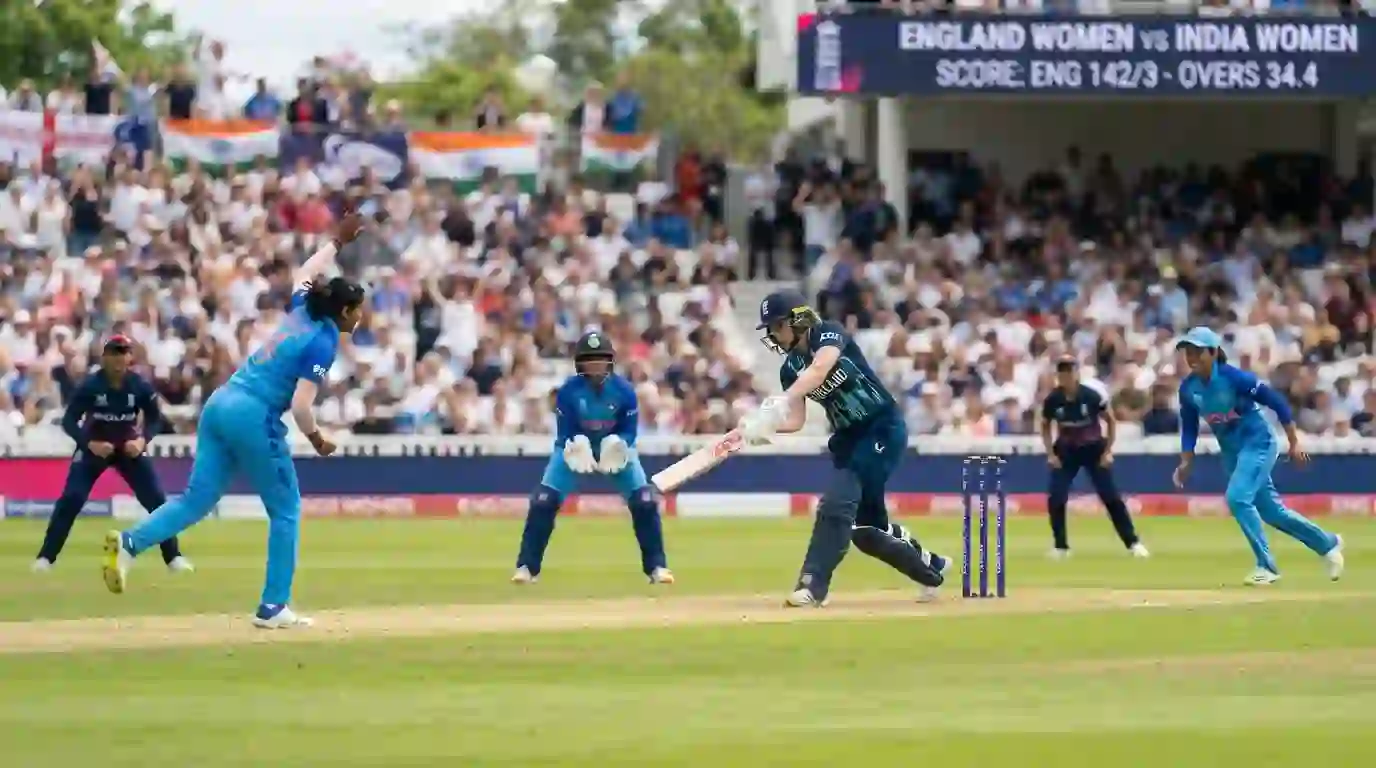
England Women vs India Women: Harmanpreet Kaur and Kranti Goud Seal India’s Series Victory
Raw totals alone make england women vs india women look like a narrow 13-run contest. That margin hides the tension: England rebuilt from 8/2 and approached a record chase, only to lose control in the last 10 overs. This data-led breakdown explains India’s answer—Harmanpreet Kaur’s tempo shift, Richa Ghosh’s finishing burst and Kranti Goud’s six-wicket spell—through phase scores, player statistics and efficiency metrics.
India Women beat England Women by 13 runs in the third ODI on July 22, 2025, at Riverside Ground, commercially named Banks Homes Riverside, in Chester-le-Street. India made 318/5 from 50 overs before bowling England out for 305 in 49.5 overs. An official attendance number was not listed in the scorecard or the major match report reviewed, so it is recorded here as not publicly reported rather than estimated. 4 6
The match was won at both ends of India’s innings. Harmanpreet’s 102 from 84 balls and a 120-run final 10 overs raised the target to 319; Kranti then removed both England openers inside 13 balls and returned to take four more wickets late. Nat Sciver-Brunt’s 98 and Emma Lamb’s 68 produced a 162-run recovery, but India dismissed six batters in the final 10-over phase to secure the match and the ODI series 2-1. 10
Match Overview
| Information | Match Details |
|---|---|
| Event | Metro Bank Women’s ODI Series, India Women tour of England 2025 |
| Game | England Women vs India Women, 3rd ODI |
| Date | July 22, 2025 |
| Venue | Riverside Ground/Banks Homes Riverside, Chester-le-Street, County Durham |
| Attendance | Not publicly reported in the reviewed scorecard or match reports |
| Winner | India Women |
| Final Score | India Women 318/5 (50 overs); England Women 305 all out (49.5 overs) |
| Broadcast | UK: Sky Sports Cricket and Sky Go; India: Sony Sports Network and SonyLIV; USA: Willow TV |
India won the toss and chose to bat in a day-night 50-over match. The venue’s own spectator guide confirms the Banks Homes Riverside naming and 1:00 p.m. local start, while the broadcast listings identify Sky Sports in the UK and Sony’s television and streaming services in India. 2 3
Core England Women vs India Women 3rd ODI Statistics
The table below uses cricket-specific equivalents for the team comparison. Dot-ball, boundary-share and phase figures are calculated from the published scorecard and ball-by-ball record; rounding may create minor decimal differences. 4
| Team Metric | India Women | England Women |
|---|---|---|
| Runs | 318 | 305 |
| Wickets lost | 5 | 10 |
| Balls used | 300 | 299 |
| Run rate | 6.36 | 6.12 |
| Powerplay score | 52/0 | 22/2 |
| Final 10-over phase | 120/2 | 77/6 |
| Fours | 35 | 23 |
| Sixes | 2 | 2 |
| Boundary runs | 152 | 104 |
| Boundary share of total | 47.8% | 34.1% |
| Dot balls | 139 | 121 |
| Dot-ball rate | 46.3% | 40.5% |
| Extras | 10 | 12 |
| Runs per wicket lost | 63.60 | 30.50 |
| Highest partnership | 110 | 162 |
England Women vs India Women Powerplay Gap
- India’s openers reached 52/0 after 10 overs; England were 22/2. That 30-run powerplay gap gave the visitors both scoreboard height and full batting resources.
- In the ENG-W vs IND-W 2025 decider, England’s first two wickets fell at 7 and 8. The chase immediately became a repair job rather than a controlled pursuit of 319.
Boundary Production in the ENG-W vs IND-W 2025 Decider
- India struck 37 boundaries to England’s 25 and collected 152 boundary runs, 48 more than the home side.
- England partly compensated with 116 singles to India’s 92, but rotation could not erase the damage caused by India’s 16 fours and two sixes in overs 41-50.
Wicket Preservation and Scoring Efficiency
- India scored 63.60 runs per wicket lost, more than double England’s 30.50. That resource advantage allowed Richa Ghosh to attack without exposing the lower order.
- England’s 162-run third-wicket stand was the match’s largest, yet the hosts still lost all 10 wickets. One dominant partnership could not match India’s deeper sequence of contributions.
Harmanpreet Kaur 102 and the Death-Overs Split
- The Harmanpreet Kaur 102 was paced in two distinct parts: her first 50 required 54 balls, while her next 52 came from only 30.
- India scored 120 in the final 10 overs. England needed 91 from the corresponding final phase but made 77 while losing six wickets.
Innings-by-Innings Analysis
First Innings: India Women 318/5
| Overs | Phase Score | Wickets Lost | Cumulative Score |
|---|---|---|---|
| 1-10 | 52 | 0 | 52/0 |
| 11-20 | 35 | 2 | 87/2 |
| 21-30 | 60 | 0 | 147/2 |
| 31-40 | 51 | 1 | 198/3 |
| 41-50 | 120 | 2 | 318/5 |
- Smriti Mandhana and Pratika Rawal provided a wicketless start, even though Sophie Ecclestone later slowed the innings with a 10-over return of 1/28.
- India absorbed a 35-run stretch between overs 11 and 20, then rebuilt through Harmanpreet and Harleen Deol. Harleen’s dismissal at 162/3 brought Jemimah Rodrigues into the match at the ideal point for acceleration.
- Harmanpreet and Jemimah added 110 for the fourth wicket. Richa then made 38 not out from 18 balls, pushing the last-10-over output to 120 and turning 198/3 after 40 into 318/5. 4
Second Innings: England Women 305 All Out
| Overs | Phase Score | Wickets Lost | Cumulative Score |
|---|---|---|---|
| 1-10 | 22 | 2 | 22/2 |
| 11-20 | 66 | 0 | 88/2 |
| 21-30 | 80 | 0 | 168/2 |
| 31-40 | 60 | 2 | 228/4 |
| 41-49.5 | 77 | 6 | 305 all out |
- Kranti Goud bowled Tammy Beaumont for 2 and had Amy Jones caught for 4, leaving England 8/2 in the third over and 22/2 after the powerplay.
- Sciver-Brunt and Lamb answered with 146 runs across overs 11-30 and shared 162 for the third wicket. At 168/2 after 30, England had repaired the innings but still needed 151 from 120 balls.
- Shree Charani removed Lamb for 68, Deepti Sharma dismissed Sciver-Brunt for 98 after a successful review, and Dunkley’s run-out made it 228/5 at 40.2 overs. Kranti’s four late wickets prevented England’s lower order from completing the chase. 6
India Women Player Statistics
Harmanpreet Kaur Player Stats
| Runs | Balls | Fours | Sixes | Strike Rate | Catches |
|---|---|---|---|---|---|
| 102 | 84 | 14 | 0 | 121.42 | 1 |
Harmanpreet converted a careful platform into the match’s only century, moving from a 54-ball fifty to a 100 from 82 balls. Her 14 fours supplied 56 boundary runs, and she also caught Lauren Bell to complete India’s 13-run victory.
Jemimah Rodrigues Player Stats
| Runs | Balls | Fours | Sixes | Strike Rate | Catches |
|---|---|---|---|---|---|
| 50 | 45 | 7 | 0 | 111.11 | 2 |
Rodrigues attacked the middle and late overs without forcing Harmanpreet to carry every scoring option. Her 110-run partnership with the captain transformed 162/3 into 272/4, and her two catches removed Charlie Dean and Sophie Ecclestone.
Richa Ghosh Player Stats
| Runs | Balls | Fours | Sixes | Strike Rate | Dismissal | Run-out Involvement |
|---|---|---|---|---|---|---|
| 38* | 18 | 3 | 2 | 211.11 | Not out | 1 |
Ghosh generated 24 of her 38 runs in boundaries and needed only 18 balls for her unbeaten finish. She later kept cleanly under pressure, taking the catch that removed Sciver-Brunt and breaking the stumps for Dunkley’s run-out.
Kranti Goud Player Stats
| Overs | Maidens | Runs | Wickets | Economy | Dot Balls | Best Phase |
|---|---|---|---|---|---|---|
| 9.5 | 1 | 52 | 6 | 5.28 | 36 | 4/23 in her last 2.5 overs |
Kranti’s value came from timing as much as volume: two new-ball wickets reduced England to 8/2, then four late strikes closed the chase. She also supplied the throw for Dunkley’s run-out, giving her direct involvement in seven of England’s 10 dismissals. 4
England Women Player Statistics
Nat Sciver-Brunt Player Stats
| Runs | Balls | Fours | Sixes | Strike Rate | Catches |
|---|---|---|---|---|---|
| 98 | 105 | 11 | 0 | 93.33 | 2 |
Sciver-Brunt arrived at 8/2 and rebuilt the chase through placement, sweeps and controlled risk rather than immediate power. Her dismissal two short of a century left England 195/4, needing another 124 from 90 balls without their set captain.
Emma Lamb Player Stats
| Runs | Balls | Fours | Sixes | Strike Rate | Partnership with Sciver-Brunt |
|---|---|---|---|---|---|
| 68 | 81 | 5 | 0 | 83.95 | 162 runs |
Lamb survived a scoreless opening spell and grew into the innings as India turned to spin. Her 68 gave the chase structure, but her dismissal at 170/3 ended England’s only century partnership.
Alice Davidson-Richards Player Stats
| Runs | Balls | Fours | Sixes | Strike Rate | Dismissal Score |
|---|---|---|---|---|---|
| 44 | 34 | 2 | 1 | 129.41 | 287/8 |
Davidson-Richards lifted the tempo after Sciver-Brunt departed and helped carry England from 195/4 to 287/8. Her pull at 47.5 overs found Radha Yadav in the deep, removing England’s last established hitter.
Sophie Ecclestone Player Stats
| Overs | Maidens | Runs | Wickets | Economy | Dot Balls |
|---|---|---|---|---|---|
| 10 | 2 | 28 | 1 | 2.80 | 46 |
Ecclestone delivered England’s clearest bowling advantage, conceding only 28 in a match where India scored at 6.36 per over. Her control removed Mandhana and delayed India’s surge, but the other four England bowlers conceded 289 runs from their combined 40 overs.
Statistical Leaders Summary
| Category | India Women | England Women |
|---|---|---|
| Leading Scorer | Harmanpreet Kaur (102) | Nat Sciver-Brunt (98) |
| Second Leading Scorer | Jemimah Rodrigues (50) | Emma Lamb (68) |
| Top Wicket-Taker | Kranti Goud (6/52) | Five bowlers tied (1 wicket each) |
| Best Economy | Kranti Goud (5.28, among wicket-takers) | Sophie Ecclestone (2.80) |
| Most Catches | Jemimah Rodrigues (2) | Amy Jones and Nat Sciver-Brunt (2 each) |
| Leading Partnership | Kaur/Rodrigues (110) | Sciver-Brunt/Lamb (162) |
The England vs India Women scorecard presents an unusual contrast: England owned the biggest partnership and the most economical spell, yet India led the categories tied most directly to victory—total runs, wickets preserved, boundary output and strike-bowling impact. 4
Why India Women Won
Balanced Batting Around the Harmanpreet Kaur Century
| India Batter/Unit | Runs | Balls | Strike Rate |
|---|---|---|---|
| Harmanpreet: first 50 | 50 | 54 | 92.59 |
| Harmanpreet: next 52 | 52 | 30 | 173.33 |
| Jemimah Rodrigues | 50 | 45 | 111.11 |
| Richa Ghosh | 38* | 18 | 211.11 |
India did not ask one batter to attack from ball one. Mandhana, Rawal and Deol protected the innings through the first 33 overs; Harmanpreet then increased her scoring rate by more than 80 strike-rate points after reaching fifty. Rodrigues and Ghosh ensured that the captain’s acceleration became a team surge rather than an isolated century.
India Women ODI Series Win Was Built at Both Ends
| Match Phase | India | England | India’s Differential |
|---|---|---|---|
| Overs 1-10 | 52/0 | 22/2 | +30 runs, two fewer wickets lost |
| Overs 11-40 | 146/3 | 206/2 | -60 runs, one more wicket lost |
| Final phase | 120/2 | 77/6 | +43 runs, four fewer wickets lost |
England actually outscored India by 60 runs through the middle 30 overs. India still won because the visitors dominated the two highest-pressure endpoints: the field-restricted powerplay and the final assault. The last-phase differential of 43 runs was 30 greater than the final margin.
Kranti Goud’s Six Wickets Split the Chase
| Spell Segment | Overs | Runs | Wickets | Main Impact |
|---|---|---|---|---|
| New ball | 5 | 12 | 2 | Beaumont and Jones dismissed |
| Middle return | 2 | 17 | 0 | Scoring checked before final push |
| Death overs | 2.5 | 23 | 4 | Dean, Davidson-Richards, Filer and Bell removed |
The shape of Kranti Goud’s 6/52 mattered. Her opening spell forced Sciver-Brunt and Lamb to spend time repairing the chase, while her final spell denied England a last-over heist. Six wickets from one bowler also gave India a strike option that England never found; every home bowler finished with exactly one wicket. 10
Fielding and Review Decisions Converted Pressure
| Decisive Action | Match Effect |
|---|---|
| Deepti Sharma’s one-handed catch | Amy Jones out; England 8/2 |
| India’s successful review at 34.6 | Sciver-Brunt out for 98 |
| Goud/Ghosh run-out combination | Dunkley out at 228/5 |
| Rodrigues’ two deep catches | Dean and Ecclestone removed |
| Harmanpreet lbw chance not reviewed by England | India captain survived on 22 and later made 102 |
India turned marginal moments into wickets. England did not review when Harmanpreet was struck on 22, with replays indicating that she would have been out; India later used a review to remove Sciver-Brunt at the point England needed her most. That decision gap was not the entire match, but it directly affected both captains’ innings. 4
Why England Women Lost
Eight for Two Made the Required Rate More Expensive
| Chase Point | England Score | Runs Needed | Balls Left | Required Rate |
|---|---|---|---|---|
| After 2.1 overs | 8/2 | 311 | 287 | 6.50 |
| After 30 overs | 168/2 | 151 | 120 | 7.55 |
| After 35 overs | 195/4 | 124 | 90 | 8.27 |
| After 40.2 overs | 228/5 | 91 | 58 | 9.41 |
Sciver-Brunt and Lamb rebuilt expertly, but the price of early caution kept rising. Even after their 162-run stand, England still needed more than a run a ball. Once both were gone, incoming batters had no low-risk settling period.
Heavy Dependence on Sciver-Brunt and Lamb
| Dependency Metric | Value |
|---|---|
| Combined runs by Sciver-Brunt and Lamb | 166 |
| Share of England’s total | 54.4% |
| Third-wicket partnership | 162 |
| Opening pair’s combined runs | 6 |
| Runs after Lamb’s dismissal | 135/7 |
England’s two leading scorers supplied more than half the total, while the openers made six between them. Davidson-Richards and Dean attacked effectively, but their task was already shaped by a climbing rate and reduced wicket resources.
England’s Attack Could Not Support Ecclestone
| Bowling Unit | Overs | Runs Conceded | Wickets | Economy |
|---|---|---|---|---|
| Sophie Ecclestone | 10 | 28 | 1 | 2.80 |
| Other England bowlers | 40 | 289 | 4 | 7.23 |
India treated Ecclestone as the control bowler and attacked elsewhere. Lauren Bell conceded 82, Linsey Smith 74 and Charlie Dean 69; that imbalance meant Ecclestone’s 46 dot balls did not translate into sustained innings pressure. India could wait for a different matchup without losing wickets to the squeeze.
Historical Context and Season Series Breakdown
India Women Tour of England 2025 ODI Results
| Match | Date and Venue | England Women | India Women | Result |
|---|---|---|---|---|
| 1st ODI | July 16, Southampton | 258/6 | 262/6 in 48.2 overs | India won by 4 wickets |
| 2nd ODI | July 19, Lord’s | 116/2 chasing revised 115 | 143/8 in 29 overs | England won by 8 wickets, DLS |
| 3rd ODI | July 22, Chester-le-Street | 305 all out | 318/5 | India won by 13 runs |
India chased 259 in the opener, England answered in a rain-reduced second ODI, and the third match became a genuine decider. The 13-run win gave India the series 2-1 after they had also won the five-match T20I series 3-2. It was India’s second consecutive ODI series victory in England, following the 2022 success. 3 1 6
Advanced Statistical Insights
1. The 43-run finish outweighed England’s middle-overs control. India led by 30 after the first 10 overs, fell one run behind on equivalent phase scoring after 20, trailed by 21 after 30 and trailed by 30 after 40. The 120-77 final-phase swing reversed that entire pattern and created the 13-run result.
2. Boundaries offset India’s higher dot-ball rate. India faced 139 dots to England’s 121, yet scored 13 more runs. The explanation is shot value: India gained 152 boundary runs to England’s 104. England made 24 more singles, but India required fewer scoring events to create the larger total.
3. Wicket preservation multiplied late-innings efficiency. India reached 40 overs at 198/3 and could give Rodrigues, Harmanpreet and Ghosh permission to attack. England reached the equivalent point at 228/4 but was chasing a target created by India’s 120-run finish. The hosts needed 91 from the last 60 balls and then lost Dunkley two balls into that phase.
4. England’s best partnership was not its safest route to victory. The 162-run stand restored the chase but occupied 28.3 overs. That was reasonable after 8/2, yet it transferred a required rate above eight to a middle and lower order facing a set field and India’s returning strike bowler.
5. Spin volume made pace variation more valuable. India used 40 overs of spin, and the two teams used 70 spin overs combined, reported as the most in an ODI played in England. Against that pattern, Kranti’s seam movement with the new ball and pace changes at the death offered a different problem at exactly the right times. 9
6. Scoring concentration favored India’s depth. India’s top two scorers made 47.8% of the total; England’s top two made 54.4%. More tellingly, India had five batters reach at least 38, while England’s openers plus Ecclestone, Filer and Bell combined for only 14 runs.
Game Implications and Key Lessons
What the India Women ODI Series Win Meant for India
- India completed a 2-1 ODI success after winning the T20I leg 3-2, proving they could close two different limited-overs series in English conditions.
- A total of 318/5 showed that the batting order could build conservatively and still exceed six runs per over through a late surge.
- Kranti Goud’s six-wicket performance gave India a new-ball and death-overs wicket option before the 2025 Women’s World Cup. At the time, Harmanpreet’s side still had three ODIs against Australia before the tournament. 4
What the Defeat Meant for England Women
- England entered their final competitive ODI before the 2025 World Cup with unresolved new-ball batting and fielding issues; the attempted 319 chase would have been a women’s ODI record at the time. 10
- The middle order proved it could recover from 8/2, but the side remained too dependent on Sciver-Brunt to control both tempo and risk.
- The attack needed a second control option around Ecclestone. Conceding 289 from the other 40 overs left almost no margin for batting errors.
Six Key Lessons from England Women vs India Women
- Protect wickets, then accelerate: India lost only three wickets in the first 40 overs and scored 120 in the last 10.
- Powerplay wickets shape the chase: The Kranti Goud six wickets started with two dismissals in 13 balls.
- One partnership is not enough: England’s 162-run stand was larger than any India partnership, but India’s innings had more contributors.
- Review discipline changes matches: England declined a review against Harmanpreet; India successfully reviewed Sciver-Brunt’s dismissal.
- Control needs support: Ecclestone’s 1/28 could not cover an economy rate of 7.23 from the rest of England’s attack.
- Boundary access decides high chases: India’s 48-run boundary advantage was nearly four times the final winning margin.
Frequently Asked Questions
Who won the England Women vs India Women third ODI in 2025?
India Women won by 13 runs at Chester-le-Street on July 22, 2025. India scored 318/5 and bowled England out for 305 with one ball remaining.
What was the final England Women vs India Women score?
India Women made 318/5 from 50 overs. England Women replied with 305 all out from 49.5 overs while chasing 319.
Who scored the most runs in the match?
Harmanpreet Kaur was the leading scorer with 102 from 84 balls, including 14 fours. Nat Sciver-Brunt led England with 98 from 105.
What were Kranti Goud’s bowling figures?
Kranti Goud took 6/52 from 9.5 overs, including one maiden and 36 dot balls. She dismissed two top-order batters and four batters in her closing spell.
What were Nat Sciver-Brunt’s stats?
Sciver-Brunt scored 98 from 105 balls with 11 fours and a strike rate of 93.33. She also took two catches during India’s innings.
Who was Player of the Match and Player of the Series?
Harmanpreet Kaur received both awards. Her 102 in the decider anchored India’s 318/5, and India won the three-match ODI series 2-1. 2
Conclusion
The england women vs india women decider was close on the scoreboard but sharply separated by resource use. England produced the match’s biggest partnership and best economy rate, yet India preserved five extra wickets, scored 48 more boundary runs and dominated the last 10 overs by 43. Harmanpreet Kaur built the platform, Rodrigues and Ghosh expanded it, and Kranti Goud converted scoreboard pressure into wickets. India’s connected batting, fielding and bowling execution ultimately outperformed England’s outstanding individual efforts.