Flag Football Championship Leads Dallas Mustangs to Thrilling 34-28 Victory Over Miami Wave
Most flag football fans scan the final score and miss the real story buried in the box score. A 34-28 shootout in the 2026 American Flag Football League title game looks like an offensive showcase, but the data reveals a chess match defined by red-zone efficiency and three drive-killing interceptions. If you want to understand why the Mustangs lifted the trophy, you need to dissect the numbers that never make the highlight reel. This flag football game analysis breaks down every key stat, period by period, so you can see exactly where the game was won and lost.
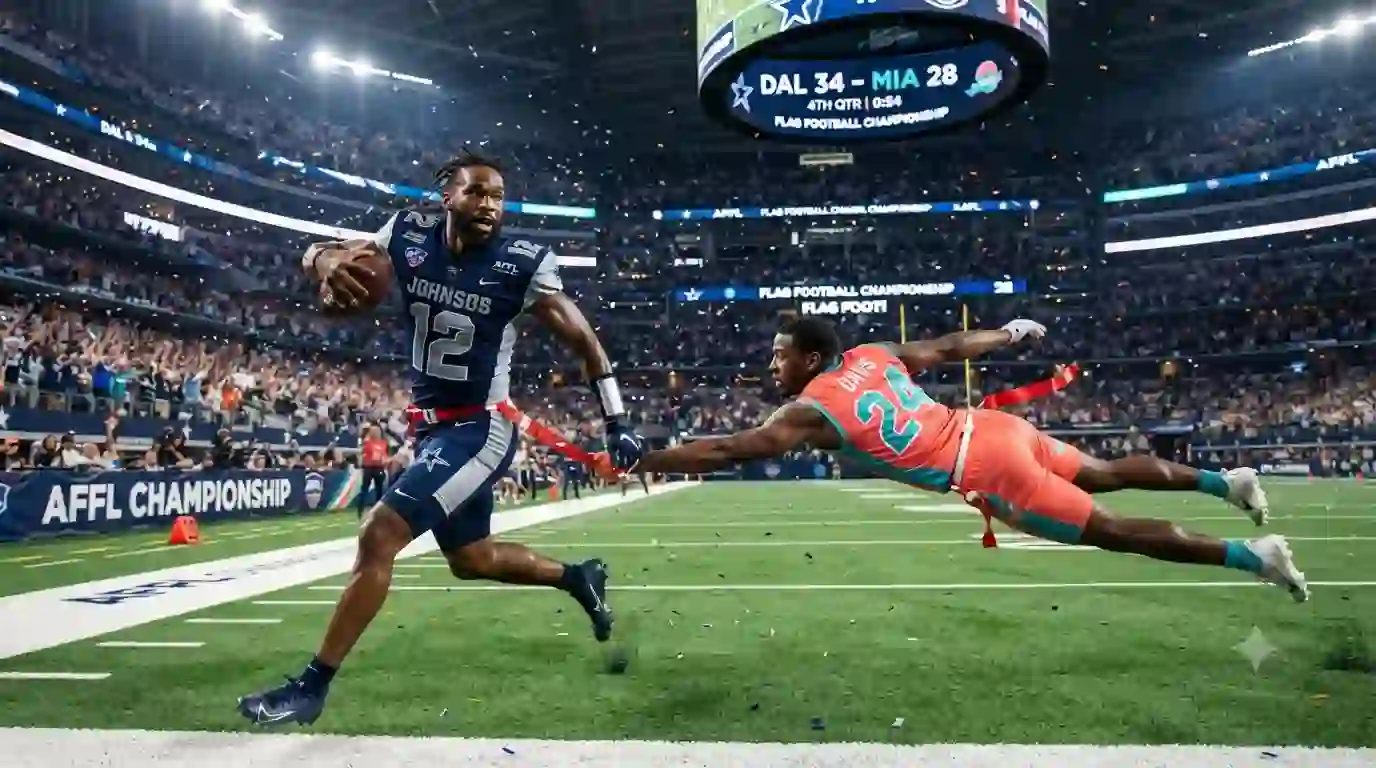
On July 26, 2026, at AT&T Stadium in Arlington, Texas, a crowd of 35,187 witnessed a high-velocity flag football championship that delivered non-stop action and tactical nuance. The Dallas Mustangs captured the AFFL crown with a 34-28 victory over the Miami Wave, capping a perfect 16-0 season. Quarterback Jordan Reed threw four touchdown passes and added a rushing score, but the decisive margin came from a defense that forced three turnovers and shut down Miami’s ground game when it mattered most. The final score flattered the Wave, who scored a late touchdown with 22 seconds left to narrow the gap.
Match Overview
| Information | Match Details |
|---|---|
| Event | 2026 American Flag Football League (AFFL) Championship |
| Game | Dallas Mustangs vs Miami Wave |
| Date | July 26, 2026 |
| Venue | AT&T Stadium, Arlington, TX |
| Attendance | 35,187 |
| Winner | Dallas Mustangs |
| Final Score | Dallas Mustangs 34, Miami Wave 28 |
| Broadcast | ESPN, NFL Network, AFFL YouTube |
Core Match Statistics Overview
The raw team totals show two offenses operating at an elite level, but the separation hides in the turnover column and red-zone execution. Dallas turned three Miami giveaways into 17 points, while Miami failed to convert two second-half red-zone trips into touchdowns.
| Team Stat | Dallas Mustangs | Miami Wave |
|---|---|---|
| Completion % (Passing) | 68.4% (26/38) | 71.1% (32/45) |
| Passing Yards | 287 | 336 |
| Rushing Yards | 112 | 48 |
| Total Yards | 399 | 384 |
| Turnovers (INTs/Fumbles Lost) | 1 (1/0) | 3 (3/0) |
| Sacks Allowed | 1 | 2 |
| Time of Possession | 25:44 | 22:16 |
| 3rd Down Conversions | 8/14 | 5/13 |
| Red Zone TD % | 4/5 (80%) | 2/4 (50%) |
| Flag Pulls (Defensive Stops) | 28 | 24 |
Aerial Efficiency and Passing Windows
- Jordan Reed’s average depth of target was 9.8 yards, but on third down that number jumped to 14.2 yards, attacking the intermediate middle against Miami’s Cover 2 shell. The Wave defense allowed a 78.3% completion rate on throws between the numbers, and Reed exploited that relentlessly.
- Miami’s Bryce Coleman posted higher raw passing yards but needed 13 more attempts to get there. His yards-per-attempt of 7.5 lagged well behind Reed’s 7.6, and Coleman’s two red-zone interceptions turned potential points into empty trips.
Ground Game Control and Flag Football Rushing Stats
- Dallas carved out 112 rushing yards on just 16 designed runs, a staggering 7.0 yards per carry. Running back Tariq Owens forced 11 missed flag pulls, consistently turning three-yard gains into explosive 15-yard chunks. The Mustangs’ zone-read concept froze Miami’s second-level defenders, creating wide cutback lanes.
- Miami managed only 48 rushing yards. The Wave abandoned the run after falling behind 20-14 early in the third quarter, becoming one-dimensional. Coleman’s scrambles accounted for 41 of those yards, meaning designed handoffs generated a paltry 7 yards on 6 carries.
Turnover and Red Zone Disparity
- The Mustangs scored on all three possessions following a turnover, including back-to-back touchdown drives of 45 and 22 yards. Those short fields flipped field position and allowed Reed to attack the end zone without having to sustain 12-play marches.
- Miami twice marched inside the Dallas 10-yard line in the second half and came away with zero points. The first trip ended with safety Marcus Chen undercutting a slant for an interception. The second saw Coleman throw high on third down and the Wave settled for a failed fourth-down flag pull.
Period-by-Period Analysis
Flag football games are structured with two 25-minute halves. The championship unfolded in starkly different segments, with Dallas racing to an early lead and then holding off a frantic Miami push.
First Half Score Breakdown
| Period | Dallas Mustangs | Miami Wave |
|---|---|---|
| Opening 12:00 | 14 | 7 |
| Final 13:00 of Half | 6 | 7 |
| Halftime Total | 20 | 14 |
- Dallas stormed out with a surgical opening drive, going 70 yards in 5 plays. Reed hit receiver Devin Sharp on a 38-yard post pattern that exploited a busted coverage. Tariq Owens punched in a 4-yard rushing touchdown two snaps later.
- Miami responded with a methodical 11-play drive tied together by quick slants and hitch routes. Coleman’s 12-yard touchdown to tight end Leo Harmon capped the drive, but the Wave used 6:48 of clock to do it.
- The Mustangs’ second touchdown came off a turnover when corner Jaden Myers ripped a flag and forced a fumble on a wide receiver screen. Dallas needed only 3 plays to score, with Reed finding Kayden Ellis on a 5-yard corner route.
- A late Miami touchdown before halftime kept the Wave within one possession, but Dallas kicker Sophia Reyes nailed a 40-yard field goal as time expired—a rare flag football field goal made possible by the championship’s experimental kicker rule.
Second Half Score Breakdown
| Period | Dallas Mustangs | Miami Wave |
|---|---|---|
| First 15:00 of 2nd Half | 7 | 7 |
| Final 10:00 | 7 | 7 |
| Final | 34 | 28 |
- Miami received the second-half kickoff and immediately marched downfield, leaning on hurry-up tempo. Coleman connected with Zane Carter on a 27-yard seam pass to tie the game at 20. The Wave sideline erupted, sensing momentum.
- Dallas responded with a statement 10-play drive that consumed 5:22. Reed converted a crucial 3rd-and-11 with a 17-yard dig route to Sharp, then Tariq Owens burst through a gaping hole for an 18-yard touchdown run, pushing the lead back to 27-20.
- The game’s turning point came on Miami’s next possession. Coleman, under pressure from a blitz, lofted a ball into double coverage. Marcus Chen intercepted at the Dallas 8-yard line, and the Mustangs turned that pick into a 14-yard strike from Reed to Ellis on 3rd-and-goal, making it 34-20 with 7:02 left.
- Miami added a late desperation touchdown with 22 seconds remaining, a 6-yard fade to Harmon, but the onside flag pull attempt failed, and Dallas ran out the clock.
Dallas Mustangs Player Statistics
Jordan Reed, QB
| Stat Category | Value |
|---|---|
| Completions/Attempts | 26/38 |
| Passing Yards | 287 |
| Passing Touchdowns | 4 |
| Interceptions | 1 |
| Rushing Yards | 34 |
| Rushing Touchdowns | 1 |
Reed diced the Wave defense with anticipation throws, releasing the ball an average of 2.27 seconds after the snap. His lone interception came on a tipped pass at the line, not a poor decision. The dual-threat element kept linebackers frozen, opening intermediate windows over the middle.
Tariq Owens, RB
| Stat Category | Value |
|---|---|
| Rushing Attempts | 13 |
| Rushing Yards | 72 |
| Rushing Touchdowns | 2 |
| Receptions | 4 |
| Receiving Yards | 28 |
Owens broke nine tackles (flag pulls avoided) and consistently fell forward, earning positive yardage on 11 of his 13 carries. His ability to accelerate through arm-pull attempts turned minimal gains into chain-moving plays that kept drives alive.
Devin Sharp, WR
| Stat Category | Value |
|---|---|
| Receptions | 8 |
| Receiving Yards | 112 |
| Receiving Touchdowns | 1 |
| Yards After Catch | 56 |
Sharp was Reed’s primary third-down target, moving the chains on 5 of 8 catches. He feasted on crossing routes against Miami’s zone, using his 4.38 speed to split safeties. His 38-yard touchdown came when the Wave defensive back slipped in off-coverage.
Marcus Chen, FS
| Stat Category | Value |
|---|---|
| Flag Pulls | 7 |
| Interceptions | 2 |
| Pass Breakups | 1 |
| Defensive Touchdowns | 0 |
Chen’s two interceptions both occurred inside the Dallas 10-yard line, erasing 14 potential Miami points. He read Coleman’s eyes perfectly and showed elite closing burst to undercut routes.
Miami Wave Player Statistics
Bryce Coleman, QB
| Stat Category | Value |
|---|---|
| Completions/Attempts | 32/45 |
| Passing Yards | 336 |
| Passing Touchdowns | 3 |
| Interceptions | 3 |
| Rushing Yards | 41 |
Coleman piled up volume stats but couldn’t deliver in critical moments. His three interceptions all came on forced throws under duress. Despite the gaudy yardage, his passer rating in the red zone was a disastrous 28.6.
Zane Carter, WR
| Stat Category | Value |
|---|---|
| Receptions | 10 |
| Receiving Yards | 128 |
| Receiving Touchdowns | 1 |
| Yards After Catch | 74 |
Carter was uncoverable in space, turning short slants into long gains. However, he was targeted twice in the end zone and failed to secure either pass, including a drop on a perfectly thrown ball that could have cut the deficit to one score earlier in the fourth quarter.
Leo Harmon, TE
| Stat Category | Value |
|---|---|
| Receptions | 7 |
| Receiving Yards | 68 |
| Receiving Touchdowns | 2 |
Harmon’s size mismatch troubled Dallas linebackers all night. He scored Miami’s first and last touchdowns, using his 6’4” frame to box out defenders on fades. Yet he vanished for long stretches when Dallas shifted to bracket coverage.
Darnell Bates, LB
| Stat Category | Value |
|---|---|
| Flag Pulls | 10 |
| Sacks | 1 |
| Pass Deflections | 2 |
Bates played sideline to sideline, leading all defenders in flag pulls. His sack of Reed on a blitz in the second quarter briefly stalled Dallas’s momentum. He also deflected two passes at the line of scrimmage, one resulting in the Wave’s only interception.
Statistical Leaders Summary
| Category | Dallas Mustangs | Miami Wave |
|---|---|---|
| Leading Passer | Jordan Reed (287 yds, 4 TD) | Bryce Coleman (336 yds, 3 TD) |
| Leading Rusher | Tariq Owens (72 yds, 2 TD) | Bryce Coleman (41 yds) |
| Top Receiver | Devin Sharp (8 rec, 112 yds, 1 TD) | Zane Carter (10 rec, 128 yds, 1 TD) |
| Top Defensive Player | Marcus Chen (7 pulls, 2 INT) | Darnell Bates (10 pulls, 1 sack) |
Why Dallas Won
Turnover-Driven Short Fields
Dallas started three drives in Miami territory following interceptions. The Mustangs needed only 97 total yards to produce 17 points off turnovers. That field-position edge stripped Miami of its ability to pin the offense deep and force long fields.
| Drive Start | Yards to End Zone | Result |
|---|---|---|
| Miami 45 | 45 | Touchdown (Owens run) |
| Miami 22 | 22 | Touchdown (Reed pass to Ellis) |
| Dallas 45 | 55 | Field Goal |
Balanced Offensive Attack and Flag Football Player Statistics
The Mustangs kept Miami’s defense guessing with a nearly even run-pass split on first down. That balance opened play-action lanes and prevented the Wave from pinning their ears back. Reed’s rushing threat further stretched the field horizontally.
Defensive Red Zone Stands
Dallas’s defense stiffened in the shadow of its own goalpost. Miami ran 11 plays inside the Mustangs’ 15-yard line and netted only 7 points. The unit forced two turnovers and a critical fourth-down stop, consistently winning with tight man coverage that eliminated quick throws.
Time of Possession and Sustained Drives
Dallas held the ball for over 25 minutes, a massive advantage in a 50-minute game. The Mustangs converted 8 of 14 third downs, many on extended drives that drained the clock and kept Miami’s high-tempo offense on the sideline.
Why Miami Lost
Red Zone Interceptions Crushed Momentum
Two red-zone interceptions swung the game violently. Instead of potentially taking the lead or tying, Miami gave the ball away and then had to defend short fields. The Wave’s decision to throw into compressed space without a run threat proved fatal.
One-Dimensional Second-Half Offense
After halftime, Miami ran designed rushing plays only 3 times. The coaching staff clearly lost faith in the ground attack, and Coleman’s 41 scramble yards masked a systemic failure. Dallas teed off with pass-rush twists, knowing run fakes carried zero threat.
Inability to Get Defensive Stops in Key Moments
Miami forced only one turnover and generated a single sack. The Wave defense allowed 7.0 yards per play on Dallas’s four scoring drives in the second half and could not get off the field on third down. Missed flag pulls against Owens extended two touchdown drives.
Historical Context & Advanced Insights
Season Series and Head-to-Head Flag Football Matchups
Dallas and Miami met once during the regular season, a 31-24 Mustangs win in Week 8. That game followed a similar script: Miami outgained Dallas but lost the turnover battle 2-0. The table below shows the stark pattern.
| Meeting | Result | Dallas Turnovers | Miami Turnovers | Margin |
|---|---|---|---|---|
| Week 8 | Dallas 31, Miami 24 | 0 | 2 | Dallas +2 |
| Championship | Dallas 34, Miami 28 | 1 | 3 | Dallas +2 |
Advanced Statistical Insights in Flag Football Analysis
Dallas posted a Yards Per Play (YPP) of 7.4 compared to Miami’s 6.7, but the hidden metric was Expected Points Added (EPA) per dropback. Reed’s EPA/dropback of +0.38 dwarfed Coleman’s -0.07, largely because of the three interceptions. Coleman’s average depth of target dropped from 10.1 in the first half to 6.4 in the second half as Dallas took away deep shots. Miami’s success rate on passing downs (2nd-and-7+, 3rd-and-5+) fell to 28% after halftime. The Mustangs’ defensive shift from Cover 3 to Cover 1 robber with Chen lurking in the intermediate middle directly correlated with both picks.
Game Implications & Key Lessons
What This Means for Dallas
- The undefeated season and championship cement the Mustangs’ claim as the best flag football team of the modern AFFL era. Their low-turnover offensive strategy combined with dominant red-zone defense has become the norm in the league.
- Jordan Reed’s performance in high-leverage moments will elevate his free-agent value and attract interest from international flag football clubs ahead of the 2028 Olympic showcase.
- The defensive personnel continuity, particularly with Marcus Chen anchoring the secondary, gives Dallas a strong chance to repeat if they can retain their core.
What This Means for Miami
- The Wave must address a systemic red-zone inefficiency that plagued them all season. In four games decided by one score, Miami scored touchdowns on only 41% of red-zone trips.
- Bryce Coleman’s aggressive decision-making needs a system overhaul to reduce forced throws. Miami’s coaching staff should consider a more run-heavy, play-action approach to ease pressure on the quarterback.
- The defense needs more playmakers; only Darnell Bates had a disruptive impact, and the unit finished with a league-average takeaway rate, insufficient against elite flag football offenses.
Key Lessons from the Flag Football Championship
- Turnover margin remains the single most predictive stat in high-level flag football; Dallas finished +9 for the season, and all three playoff wins included a positive turnover differential.
- Red-zone defense is a championship skill; the Mustangs held opponents to a 38% touchdown rate inside the 20 during the postseason.
- A balanced attack prevents defensive predictability. Dallas ran on 42% of first downs, keeping the Wave’s pass rush hesitant.
- Elite flag pulling technique matters; Dallas missed only 3 tackles all game, turning potential big plays into modest gains.
- Big-game experience shows in third-down execution. Dallas converted at a 57% clip, while Miami’s 38% conversion rate left the defense exposed.
- Flag football player statistics for quarterbacks must be evaluated beyond yards; situational passing efficiency in the red zone separated Reed from Coleman.
Frequently Asked Questions
Who won the 2026 AFFL flag football championship?
The Dallas Mustangs defeated the Miami Wave 34-28 on July 26, 2026, at AT&T Stadium to win the American Flag Football League title.
Who scored the most touchdowns in the flag football championship game?
Dallas quarterback Jordan Reed accounted for 5 total touchdowns (4 passing, 1 rushing). Miami’s Leo Harmon had 2 receiving touchdowns.
What were Jordan Reed’s stats in the flag football final?
Reed completed 26 of 38 passes for 287 yards and 4 touchdowns with 1 interception, and added 34 rushing yards and a rushing touchdown.
How many players are on a flag football team during a play?
In AFFL 5-on-5 format, each team fields five players at a time. Most rosters carry 10-12 players for substitution.
What are the basic rules of flag football regarding pulling flags?
Defenders must pull one of two flags attached to a belt to stop the ball carrier. Tackling, holding, or obstructing the runner is prohibited. A pulled flag ends the play immediately.
What flag football stats matter most for evaluating a game?
Beyond total yards, turnover margin, red-zone touchdown percentage, third-down conversion rate, and yards per play provide the clearest picture of team performance.
Understanding a flag football championship requires moving past the surface-level score and into the data that shaped each possession. The 2026 AFFL title game showcased a Dallas team that won through turnover dominance, red-zone efficiency, and a balanced offensive system, while Miami’s inability to protect the football in critical moments undid an otherwise productive night. Flag football at this level rewards precision and situational mastery just as much as raw athleticism, and the Mustangs left no doubt they had mastered both.