Esoteric Meaning: Complete Guide to the Hidden Knowledge Term
Introduction
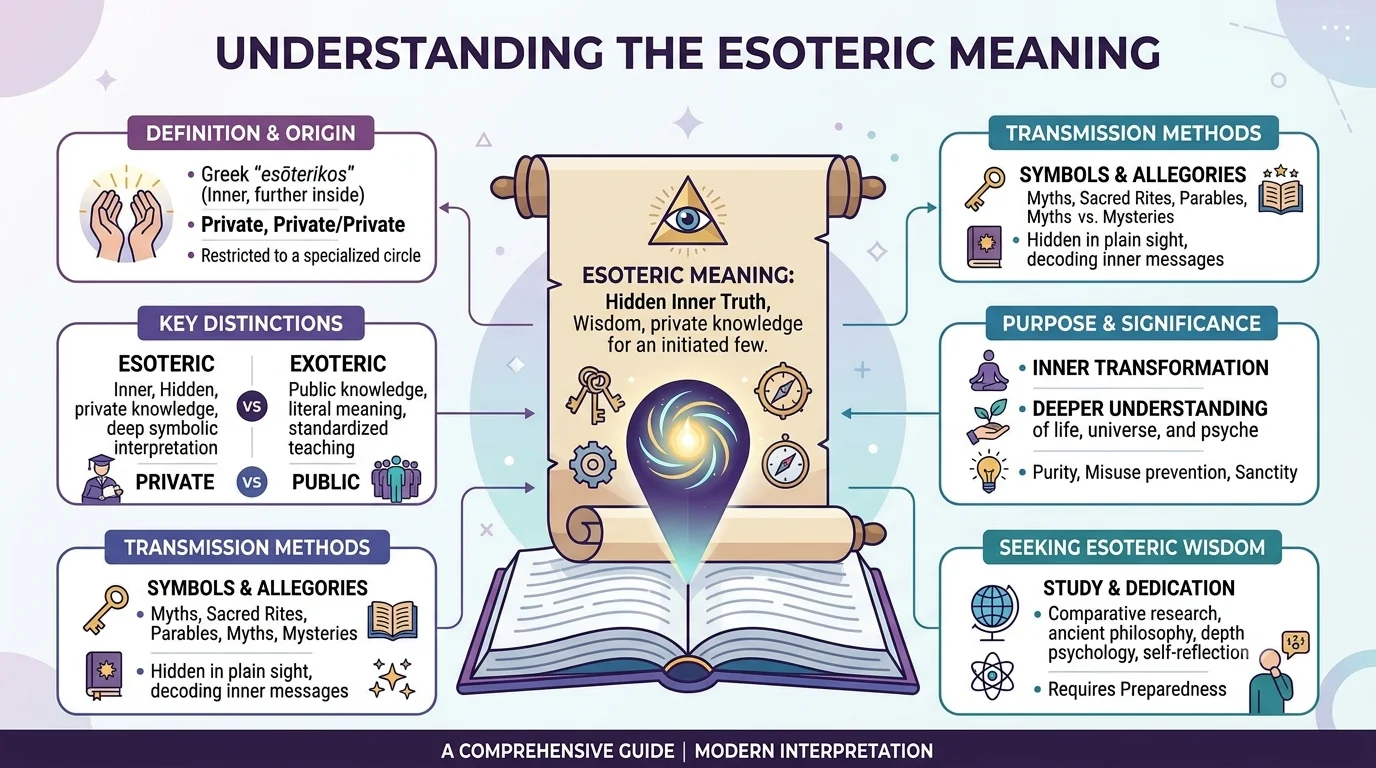
You have probably encountered the word “esoteric” in books, conversations, or online articles. Maybe you wondered what it truly means. The esoteric meaning refers to knowledge or teachings understood by only a small, select group of people. This guide explores the complete esoteric meaning—from its ancient Greek origins to its modern usage in philosophy, religion, literature, and even computer programming. Understanding the esoteric meaning opens doors to a richer appreciation of how knowledge has been protected, shared, and hidden throughout human history.
What Is the Esoteric Meaning?
The esoteric meaning describes anything intended for or understood by only a small group with specialized knowledge or interests. Dictionary.com defines esoteric as “obscure and only understood or intended to be understood by a small number of people with special (and perhaps secret) knowledge”. Merriam-Webster offers a similar esoteric meaning: “only taught to or understood by members of a special group”.
The esoteric meaning often carries connotations of secrecy and exclusivity. It describes knowledge not readily accessible to the general public. The esoteric meaning also implies that understanding requires initiation, training, or a particular intellectual background.
Where Does the Esoteric Meaning Come From?
The esoteric meaning traces back to ancient Greece. The word derives from the Greek esōterikós, based on the comparative form of esō, meaning “within”. The term was first recorded in a work by Lucian of Samosata in the 2nd century CE.
The ancient Greek mysteries applied the esoteric meaning to those who were initiated (eso, “within”) versus those who were not (exo, “outside”). Philosophers later adopted the distinction. The esoteric meaning was transferred to denote the difference between teachings given to all pupils and higher, secret philosophy reserved for privileged disciples. The Pythagoreans likely adopted this distinction, and it was also attributed to Plato and Aristotle.
The word entered the English language around 1660. The esoteric meaning has evolved since then, but the core idea of inner, hidden knowledge has remained consistent.
Esoteric vs. Exoteric: Understanding the Opposite
To fully grasp the esoteric meaning, you must understand its opposite: exoteric. The esoteric meaning refers to inner, hidden knowledge. Exoteric refers to knowledge designed for or understood by the general public.
| Aspect | Esoteric | Exoteric |
|---|---|---|
| Greek Root | esō (“within”) | eksô (“outside”) |
| Audience | Select few, initiates | General public |
| Access | Restricted, requires initiation | Open, publicly available |
| Knowledge Type | Secret, hidden, inner | Public, outer, accessible |
| Examples | Mysticism, Kabbalah, esoteric Buddhism | Mainstream religion, public education |
The esoteric meaning and exoteric meaning are complementary. One cannot exist without the other. Esoteric knowledge presupposes the existence of exoteric knowledge available to everyone.
Synonyms and Related Terms
Several words share similar esoteric meaning:
Abstruse – Difficult to penetrate or understand
Arcane – Requiring secret or mysterious knowledge
Recondite – Incomprehensible to one of ordinary understanding
Occult – Hidden, secret, beyond ordinary understanding
Cryptic – Having a meaning that is mysterious or obscure
Mystical – Having a spiritual meaning beyond ordinary understanding
The esoteric meaning overlaps with these terms but carries a distinct connotation of intentional exclusivity. Something arcane might be simply difficult to understand. Something esoteric is difficult to understand and intended for a select group.
The Esoteric Meaning in Philosophy
Philosophy has a rich relationship with the esoteric meaning. Ancient philosophers distinguished between exoteric teachings for the general public and esoteric teachings for advanced students.
The Pythagoreans were known for their esoteric meaning traditions. They reserved certain mathematical and philosophical doctrines for initiated members only. Plato’s unwritten doctrines—teachings never committed to writing—represent another example of the esoteric meaning in philosophy.
The esoteric meaning in philosophy suggests that some truths cannot be communicated through ordinary language or public teaching. These truths require personal initiation, intellectual preparation, and direct experience. The esoteric meaning thus points to a level of understanding beyond what books and lectures can convey.
The Esoteric Meaning in Religion and Spirituality
Religious traditions worldwide incorporate the esoteric meaning into their teachings. The esoteric meaning often refers to the hidden, inner dimension of religious practice.
Esoteric Buddhism
Esoteric Buddhism, also known as Vajrayana or Tantrayana, represents the esoteric meaning in Buddhist practice. These teachings are conveyed secretly or implicitly and held to be beyond the understanding of ordinary persons. Esoteric Buddhist schools include many Tibetan lineages and Chen-yen Buddhism. They incorporate symbolic gestures (mudras), spells (mantras), and diagrams (mandalas).
Kabbalah
Jewish Kabbalah represents the esoteric meaning within Judaism. It offers mystical interpretations of the Torah and explores the hidden nature of God and creation. The esoteric meaning in Kabbalah was traditionally reserved for mature scholars who had mastered exoteric Jewish law.
Sufism
Islamic Sufism embodies the esoteric meaning within Islam. Sufis pursue the inner, spiritual dimension of the faith. The esoteric meaning in Sufism involves direct experience of the divine through practices like meditation, chanting, and spiritual guidance.
Hermeticism and Gnosticism
The esoteric meaning also appears in Hermeticism, Gnosticism, alchemy, and astrology. These traditions emphasize hidden knowledge that reveals deeper truths about the universe and human existence. The esoteric meaning in these traditions often involves symbolic language and allegorical interpretation.
The Esoteric Meaning in Literature
Writers have long employed the esoteric meaning in their work. The esoteric meaning in literature refers to hidden symbolism, obscure references, and layers of meaning accessible only to knowledgeable readers.
Modernist poets like W.B. Yeats drew on the esoteric meaning of occult and mystical traditions. Yeats created a personal mythology that operated through the esoteric meaning of symbols and images. Italian Hermetic poets like Giuseppe Ungaretti employed the esoteric meaning through cryptic brevity and obscure language.
The esoteric meaning in literature challenges readers to look beyond the surface. It rewards those who bring specialized knowledge to their reading. The esoteric meaning creates a bond between writer and reader—an understanding shared by few.
The Esoteric Meaning in Everyday Language
The esoteric meaning appears frequently in everyday conversation and writing. People use the term to describe:
- Hobbies and interests: “He collects esoteric vinyl records from obscure 1970s bands”
- Academic subjects: “Quantum physics can seem esoteric to the average person”
- Trivia and knowledge: “She won the quiz show by answering esoteric questions about ancient history”
- Political discourse: “The debate centered on esoteric rules of parliamentary procedure”
The esoteric meaning in everyday usage often carries a slightly negative connotation. Something esoteric might be seen as unnecessarily obscure or elitist. However, the esoteric meaning can also be positive—it suggests depth, sophistication, and specialized expertise.
The Esoteric Meaning in Computer Programming
The esoteric meaning has found an unexpected home in computer science. Esoteric programming languages (often shortened to “esolangs”) are programming languages designed to test the boundaries of computer language design, as a proof of concept, or as a joke.
The esoteric meaning in programming distinguishes these experimental languages from practical languages used by working developers. Esolangs are intentionally unusual, sometimes unusable or uncomputable. They explore weird ideas and push the limits of what a programming language can be.
Examples of esoteric programming languages include Brainfuck, INTERCAL, and Whitespace. The esoteric meaning in this context reflects the playful, experimental side of computer science.
Examples of Esoteric Knowledge and Practices
The esoteric meaning manifests in numerous traditions and practices:
- Alchemy – The medieval pursuit of transforming base metals into gold, with deep symbolic and spiritual dimensions
- Astrology – The study of celestial bodies’ influence on human affairs
- Freemasonry – A fraternal organization with secret rituals and symbols
- Theosophy – A spiritual movement seeking hidden wisdom about the nature of divinity
- Wicca – A modern pagan religion with esoteric practices
- Zen Buddhism – A tradition emphasizing direct, non-verbal transmission of understanding
These examples share the esoteric meaning of knowledge reserved for initiates. They require study, practice, and often initiation to fully understand.
Why the Esoteric Meaning Matters
Understanding the esoteric meaning enriches your comprehension of how knowledge operates in society. The esoteric meaning reveals several important truths:
Knowledge is not equally accessible. Some understanding requires preparation, initiation, and effort. The esoteric meaning acknowledges this reality.
Depth requires commitment. The esoteric meaning reminds us that superficial understanding is not enough. True mastery demands dedication.
Community forms around shared knowledge. The esoteric meaning creates bonds between those who share specialized understanding.
Hidden knowledge protects itself. The esoteric meaning suggests that some truths cannot be forced. They reveal themselves only to those ready to receive them.
The esoteric meaning also warns against intellectual arrogance. Just because something seems esoteric does not mean it lacks value. The esoteric meaning challenges us to remain humble before knowledge we do not yet understand.
Frequently Asked Questions
1. What is the simple esoteric meaning?
The simple esoteric meaning is knowledge or teachings understood by only a small, select group of people. It refers to information that is obscure, secret, or intended for initiates rather than the general public.
2. What is the difference between esoteric and exoteric?
Esoteric refers to inner, hidden knowledge meant for a select few. Exoteric refers to outer, public knowledge meant for everyone. The esoteric meaning emphasizes exclusivity and initiation, while exoteric emphasizes accessibility and openness.
3. Where does the word esoteric come from?
The word esoteric comes from the Greek esōterikós, meaning “inner”. It was first used in ancient Greek mystery religions to distinguish initiates from non-initiates. The word entered English around 1660.
4. What are some examples of esoteric knowledge?
Examples include Kabbalah, esoteric Buddhism, alchemy, astrology, Hermeticism, Gnosticism, Freemasonry, Theosophy, and Wicca. The esoteric meaning applies to any tradition that reserves certain teachings for initiates.
5. Is esoteric the same as occult?
The esoteric meaning and occult are related but not identical. Occult literally means “hidden” and often refers to supernatural or magical knowledge. The esoteric meaning is broader, encompassing any specialized knowledge, not just supernatural traditions.
6. How can I use the word esoteric in a sentence?
Examples of the esoteric meaning in sentences: “The professor’s lecture on medieval philosophy was too esoteric for most students.” “She enjoys reading esoteric texts on ancient symbolism.” “His knowledge of wine is esoteric—he can identify any vintage by taste alone.”
Conclusion
The esoteric meaning encompasses far more than a simple dictionary definition. It represents a fundamental aspect of how human knowledge has been created, protected, and transmitted across cultures and centuries. From the ancient Greek mysteries to modern esoteric programming languages, the esoteric meaning reminds us that not all knowledge is meant for everyone.
Understanding the esoteric meaning helps us appreciate the depth and complexity of human intellectual traditions. It encourages humility before knowledge we do not yet possess. It warns against the arrogance of assuming that what we do not understand has no value.
Whether you encounter the esoteric meaning in philosophy, religion, literature, or everyday conversation, you now have the tools to understand what it truly means. The esoteric meaning is not just about secrecy—it is about the recognition that some truths require preparation, commitment, and initiation to fully grasp.
Share this guide with someone who has asked you “what does esoteric mean?” or subscribe to our newsletter for more deep dives into fascinating words and their meanings.